

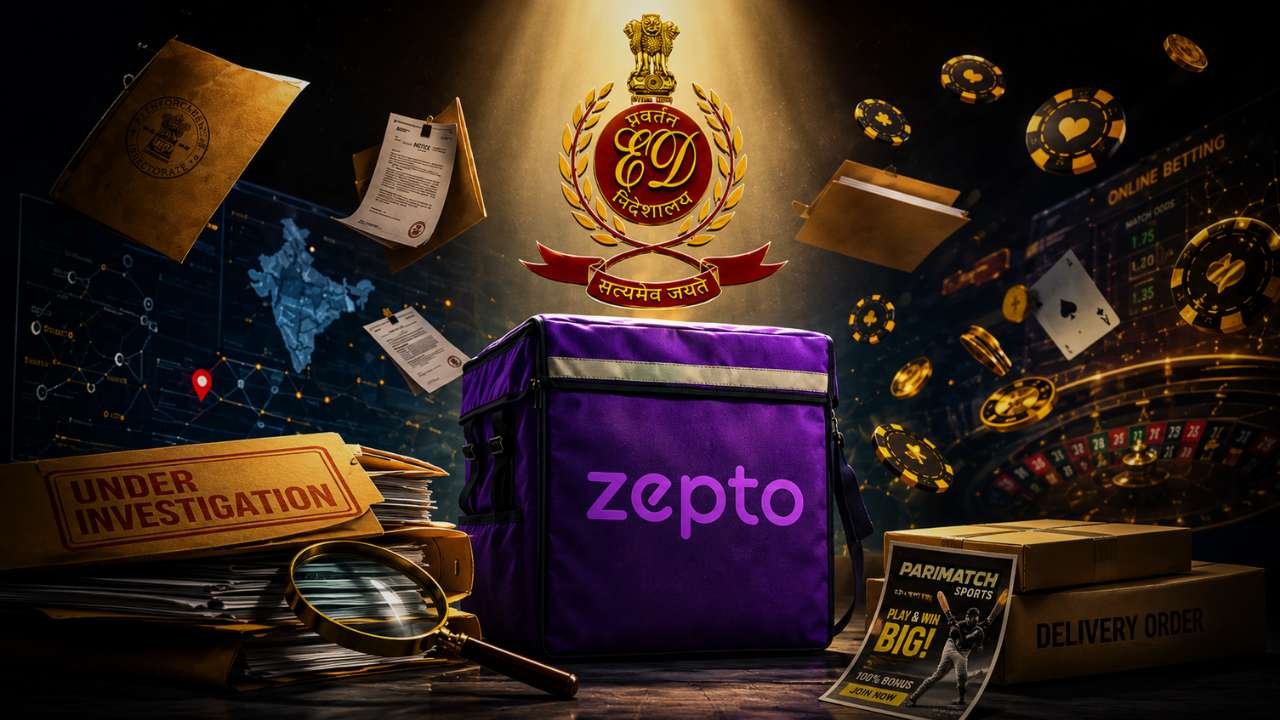
Quick-commerce company Zepto has come under the Enforcement Directorate’s (ED) scanner after reports emerged that promotional flyers of offshore betting platform Parimatch were being distributed through its grocery delivery orders. The development has raised concerns for the startup as it prepares for its planned initial public offering (IPO).
The investigation is part of a larger crackdown on illegal online betting platforms operating in India. While Zepto has denied any direct connection with Parimatch, the case has highlighted how betting companies may be using different channels to reach customers despite government restrictions.
ED Seeks Answers From Zepto
The ED has asked Zepto to explain how advertisements related to Parimatch ended up inside customer delivery packages. Officials want to know what checks were carried out before accepting the advertising campaign and whether the company verified the advertiser’s background.
The agency is also speaking to other delivery platforms to find out if similar advertising campaigns were run through their services.
Responding to the allegations, Zepto said it had no direct business relationship with Parimatch. According to the company, the advertisement campaign was handled by an external media agency in March 2025 on behalf of another entity.
Zepto clarified that it did not directly sign any contract with Parimatch, nor was it involved in any betting, gaming, or payment-related activities linked to the platform. The company added that it has fully cooperated with investigators and has connected the ED with the third-party agency that managed the campaign.
So far, no Zepto executive has been called for questioning.
The matter is important because Zepto is reportedly preparing for a $1.3 billion IPO. Any regulatory issue at this stage could attract greater attention from investors and market regulators.
ED Expands Crackdown on Offshore Betting Network
The investigation into Zepto is connected to a wider probe into offshore betting platforms, including Parimatch.
According to the ED, Parimatch allegedly earned around ₹3,000 crore from Indian users during 2024-25. Authorities claim the platform attracted users by promising large returns and easy profits.
Investigators say these betting platforms often create multiple mirror websites to avoid government blocks. They also use a network of mule bank accounts, payment agents, cryptocurrency transactions and hawala channels to move money.
The ED believes that illegal betting apps have taken thousands of crores from Indian users over the years. The overall offshore betting market is estimated to be worth around ₹85,000 crore.
One example cited by investigators involves a Mumbai businessman who reportedly lost more than ₹12 crore. After depositing large sums into a betting app, he was allegedly prevented from withdrawing his money.
As part of the investigation, the ED carried out searches at 17 locations across Maharashtra, Rajasthan, Delhi, Gujarat, Daman and Uttar Pradesh in May 2025.
During the raids, officials recovered assets worth around ₹1.56 crore, including approximately ₹1.2 crore in cash. The agency has also frozen more than ₹110 crore in assets and seized nearly 1,200 mule credit cards linked to the network.
Government and Big Tech Under Increased Scrutiny
The crackdown is not limited to betting operators. Authorities are also examining the role of digital platforms that carry advertisements for such services.
The ED has sent notices to tech giants Google and Meta, seeking information about advertisements linked to illegal betting platforms. Officials want to understand how these ads were allowed to reach users.
The issue has become more serious following reports showing a large number of betting-related advertisements online. A recent Advertising Standards Council of India (ASCI) report flagged thousands of illegal betting advertisements within just six months. Most of these ads appeared on digital platforms.
The Indian government has repeatedly warned media companies, online platforms and social media influencers against promoting betting and gambling services. Several advisories issued by the Ministry of Information and Broadcasting clearly state that betting-related advertisements and surrogate promotions are not allowed.
Many betting companies try to bypass these rules by presenting themselves as sports news websites, blogs or entertainment platforms instead of gambling operators.
The Central Consumer Protection Authority (CCPA) has also warned influencers, celebrities and advertisers against endorsing illegal betting services.
As investigations continue, the Zepto-Parimatch case highlights the risks companies face when advertising campaigns are not properly checked. The outcome of the probe could lead to stricter scrutiny of advertising partnerships, especially in sectors that operate in legal grey areas. It also shows that enforcement agencies are taking a tougher stand against illegal online betting networks and those who help promote them.