

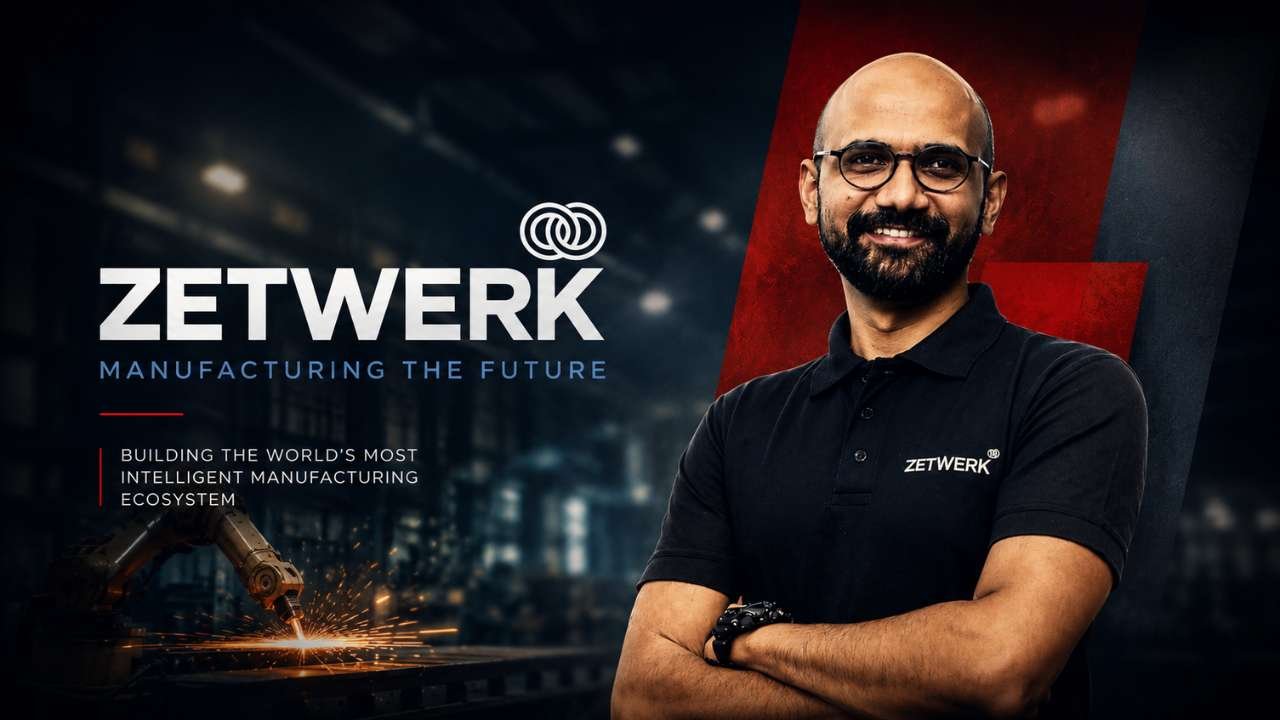
Manufacturing startup Zetwerk has entered an important phase of growth with a major leadership change, strong financial progress, and preparations for its upcoming initial public offering (IPO). The Bengaluru-based company has announced that co-founder Rahul Sharma is stepping away from his executive role to start a new AI robotics venture while continuing to support Zetwerk as a non-executive board member.
The announcement comes shortly after the company received approval from the Securities and Exchange Board of India (SEBI) for its IPO. Along with better financial performance and expansion in manufacturing, Zetwerk is now focusing on long-term growth in India and global markets.
Started as a digital manufacturing marketplace, Zetwerk has grown into one of India’s largest manufacturing technology companies, serving thousands of businesses across different industries.
Leadership changes come ahead of IPO
Rahul Sharma will no longer be involved in the company’s daily operations. Instead, he will focus on building a new AI robotics startup in the United States that aims to improve manufacturing using artificial intelligence and automation. Zetwerk will also invest in this new venture, while Sharma will continue to be part of the company’s board as a non-executive director.
Following his exit from daily operations, the company has reshuffled key responsibilities. Shreerang Godbole, who currently heads the electronics business, will take over Sharma’s role in that division. Co-founder Vishal Chaudhary will lead the aerospace and defence business, while CEO Amrit Acharya will continue to lead the company.
The leadership changes come after a few senior executives recently left the company, including electronics business president Josh Foulger and Chief Marketing Officer Amrit Raj. At the same time, former Telecom Secretary Aruna Sundararajan has joined Zetwerk’s board, adding more experience as the company prepares to become a listed company.
Zetwerk confidentially filed its Draft Red Herring Prospectus (DRHP) in March 2026 and received SEBI approval earlier this month. The company plans to raise between ₹4,200 crore and around $550 million through a mix of fresh shares and an Offer for Sale (OFS) by existing investors.
Before the IPO, the company is also planning to raise another ₹500 crore through a pre-IPO funding round to strengthen its finances.
Better profits after changing business strategy
Zetwerk’s financial performance improved because of a planned change in its business model. Instead of focusing on low-margin trading, the company decided to give more importance to manufacturing services, which offer better profits.
During FY25, Zetwerk reduced its trading business and increased its manufacturing services business. This led to a drop in overall revenue, but the company earned better margins and improved its financial health.
For the first time, Zetwerk reported a positive EBITDA of ₹145 crore in FY25. It also reduced its net loss by nearly 60% compared to the previous financial year. This shows that the company’s strategy is starting to deliver results.
For FY26, Zetwerk expects its operating revenue to grow to nearly ₹15,900 crore. It also has an order book worth more than ₹12,000 crore, giving it strong business visibility for the next 12 to 18 months.
The company has cash and cash equivalents of around ₹3,000 crore to ₹3,200 crore. It also has debt of about ₹2,700 crore while maintaining a healthy net worth of over ₹4,500 crore.
However, rating agency CRISIL has given the company’s proposed debt issue an ‘A-/Negative’ rating. The negative outlook is mainly due to the financial impact of shutting down its loss-making civil EPC business and the costs involved in that process.
Manufacturing expansion to support future growth
Zetwerk is investing heavily in manufacturing as it moves from an asset-light business model to owning more manufacturing facilities. The company plans to invest around ₹1,500 crore, mainly in electronics manufacturing and renewable energy.
Its electronics business is expanding quickly. Zetwerk already has the capacity to manufacture millions of wearable devices and televisions every year. It is now entering laptop manufacturing and plans to produce up to one lakh laptops every month.
The company has also opened a new ₹100-crore electronics manufacturing facility in Tamil Nadu. The 15-acre plant includes advanced Surface Mount Technology (SMT) lines and is expected to create around 1,200 jobs. It will manufacture products for sectors such as defence, aerospace, automotive and medical devices.
Zetwerk is also entering the electric vehicle (EV) components business. Instead of making complete EVs, it will manufacture products like battery management systems, vehicle control units, motor controllers and battery packs. Its new plant in western India will be able to produce more than 20,000 EV battery packs every month.
The company is also benefiting from the global “China+1” strategy, as many international companies are shifting their supply chains to India. Zetwerk now serves more than 2,000 enterprise customers across over 20 industries, with international business becoming an increasingly important part of its revenue.
To manage these large manufacturing projects, the company uses its own software platform called Zetwerk OS. The system helps customers track production, monitor quality and manage deliveries in real time. Zetwerk has also strengthened its business through several strategic acquisitions in sectors such as aerospace, defence, industrial manufacturing and energy.
With stronger financials, growing manufacturing capacity, rising global demand and an upcoming IPO, Zetwerk is preparing for its next stage of growth while continuing to invest in advanced manufacturing technologies.