

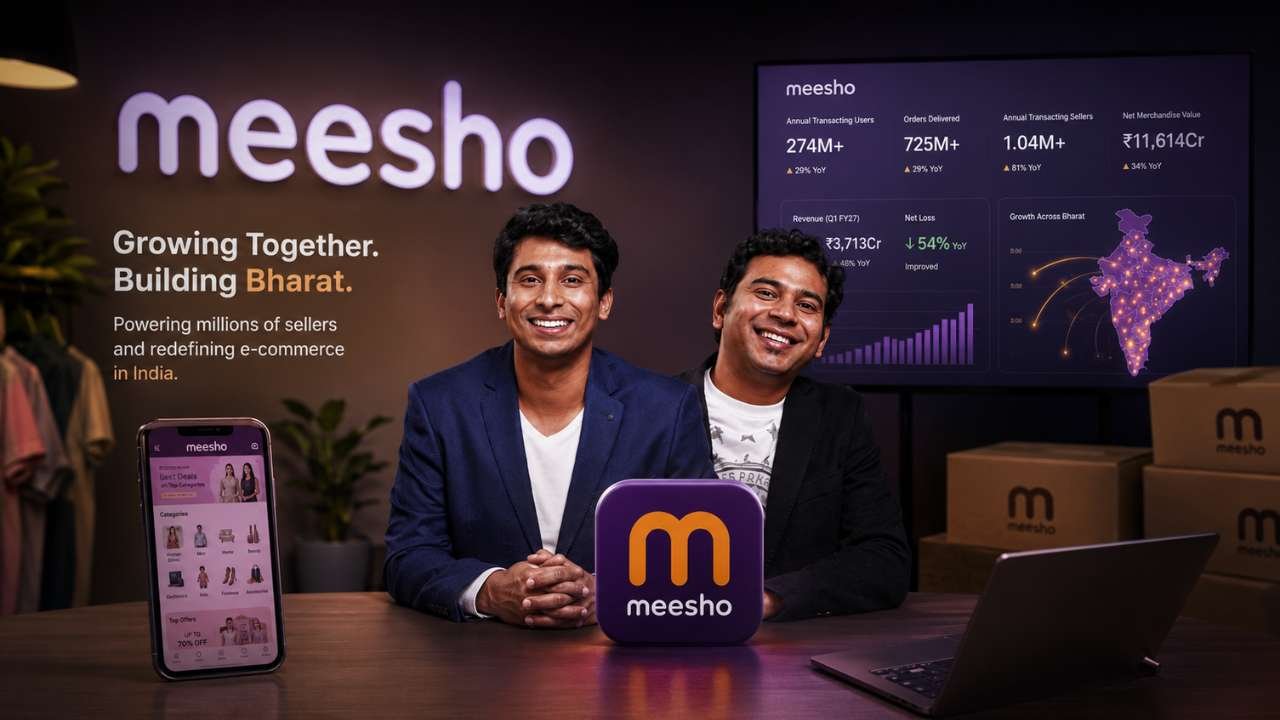
Meesho started FY27 on a strong note by reporting higher revenue and lower losses in the first quarter ended June 30, 2026. The e-commerce company continued to grow its business with more customers, more sellers, and higher order volumes, especially from smaller cities and towns across India.
The company reported ₹3,712.8 crore in revenue from operations during Q1 FY27, a 48.3% increase compared to ₹2,503.9 crore in the same quarter last year. Meesho’s total income also grew to ₹3,826.4 crore, helped by over ₹113 crore in other income.
The company’s financial position also improved during the quarter. Its consolidated net loss fell by 54% year-on-year to ₹132.8 crore, compared to ₹289.4 crore in Q1 FY26. The company’s PAT margin improved to -3.58%, showing better control over costs as it moves closer to profitability.
More orders and sellers drive Meesho’s growth
Meesho’s marketplace business remained its biggest source of revenue, contributing ₹3,707 crore during the quarter. The company’s newer businesses, including digital financial services and logistics, added only a small share to the overall revenue.
The platform processed 725 million orders during the quarter, up 29% from a year ago. Meesho now has 274 million annual transacting users, while the average customer places 10.33 orders every year.
The company continued to expand its reach in smaller cities and towns. The number of annual transacting sellers increased by 81% to more than 1.04 million. Around 45% of these sellers are from Tier-2 and smaller towns, showing Meesho’s growing presence outside metro cities.
Meesho also saw strong growth in its newer business categories. Its branded products platform, Meesho Mall, recorded 93% growth in Net Merchandise Value (NMV). Its creator-led shopping business, known as content commerce, grew 141%, supported by more than 1.7 million active content pieces that helped generate customer orders.
The company is also using artificial intelligence to improve its operations. According to Meesho, AI tools have more than doubled the productivity of its engineering teams. AI is also being used for product recommendations, fraud detection, and multilingual customer support for users in regional markets.
At the same time, total expenses increased by around 43% to ₹3,959 crore. Employee benefit expenses rose to ₹243 crore, while depreciation and amortisation expenses stood at ₹19.6 crore. However, the company’s ESOP expenses declined during the quarter.
Meesho’s marketplace contribution margin improved to 4.6% of NMV, while its adjusted marketplace EBITDA loss became smaller. However, the consolidated adjusted EBITDA loss increased because the company continued investing in its new businesses.
Meesho expands grocery business and strengthens payments
Along with improving its financial performance, Meesho continued investing in future growth. During the quarter, the company announced the acquisition of Kirana Club, a Singapore-based company that operates a B2B network of millions of kirana retailers. The deal, worth up to ₹202.08 crore, is expected to help Meesho expand its presence in India’s large grocery market.
The company also approved an investment of up to ₹75 crore in Meesho Grocery Private Limited to strengthen its grocery logistics business. In addition, Meesho completed the process of making Meesho Payments Private Limited a wholly owned subsidiary and approved a fresh investment of nearly ₹100 crore into the payments business.
CEO Vidit Aatrey said the company has no plans to enter the 10-minute quick commerce market. Instead, Meesho will continue focusing on its Farmiso grocery model, where local shopkeepers collect customer orders and manage deliveries. According to the company, this model helps keep prices low for customers who are willing to wait a little longer instead of paying extra for faster delivery.
Farmiso currently operates in more than 25 towns in Karnataka, and Meesho plans to expand the service to over 200 cities in the coming years.
Governance changes and legal matters remain under watch
Meesho also made changes to its corporate governance structure during the quarter. The company updated its Articles of Association, allowing founders Vidit Aatrey and Sanjeev Kumar to continue on the board if they maintain the required shareholding. Large non-promoter investors meeting certain ownership conditions will also get the right to nominate directors to the board.
At the same time, Meesho continues to face legal and regulatory issues. A proxy advisory firm recently questioned the GST classification used by Meesho’s logistics arm, Valmo Transportation. The firm claimed the company may have used a lower GST category for freight services. Meesho has denied the allegations and said it follows all tax laws and has not received any notice from regulators.
The company is also challenging income tax demands of more than ₹2,000 crore for different assessment years through legal channels. Apart from this, Meesho continues to face ongoing cases related to consumer protection, product compliance, and other regulatory matters mentioned in its public filings.
With more online shoppers coming from smaller cities and towns, Meesho continues to focus on affordable products, technology, and expanding its seller network. While legal issues remain under scrutiny, the company’s latest quarterly results show steady financial improvement and its long-term plan to strengthen its position in India’s growing e-commerce market.