

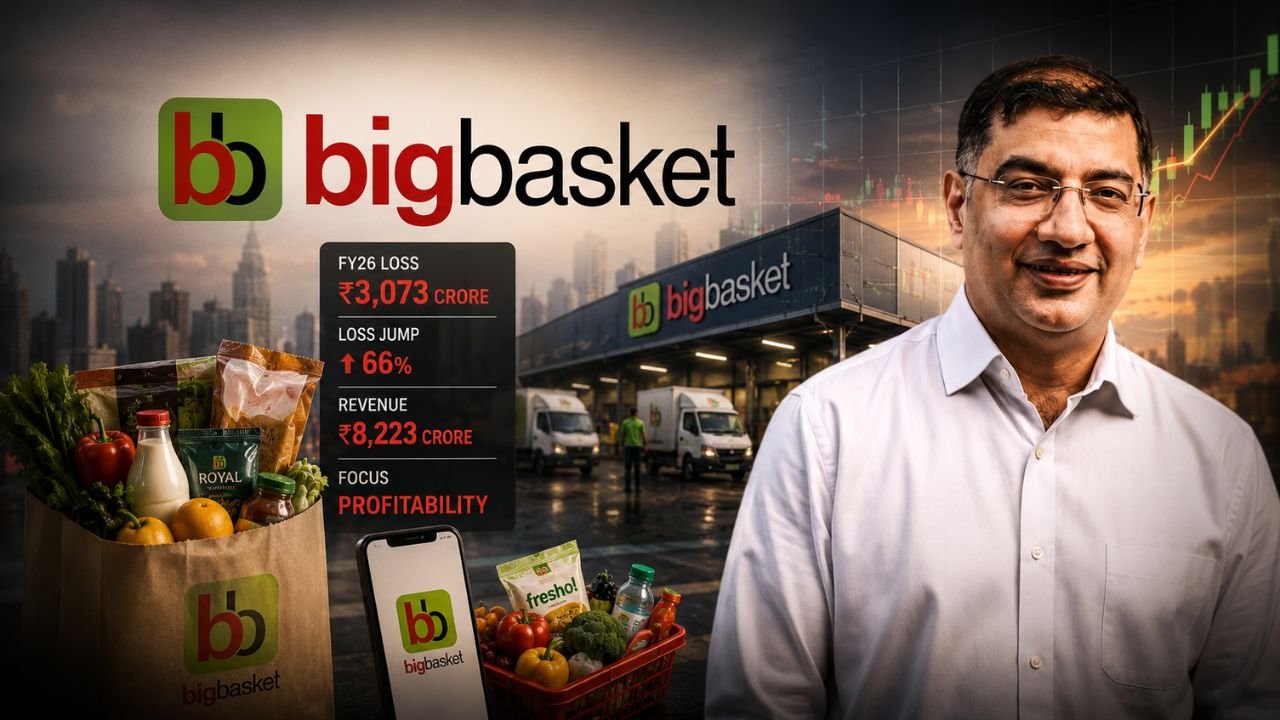
BigBasket’s push into the fast-growing quick commerce market has led to a sharp rise in losses during FY26. While the Tata Group-backed grocery platform continued to expand its business and open more dark stores, its higher spending affected overall profits.
The latest financial results show that BigBasket is growing its business, but the cost of running quick deliveries has increased much faster than its revenue. The company is now focusing on improving profits while continuing to compete with major players in the quick commerce industry.
BigBasket’s consumer business reported revenue of ₹8,223 crore in FY26, up 7.7% from ₹7,634 crore in FY25. However, its net loss jumped 66% to ₹3,073 crore, compared to ₹1,850 crore in the previous year. Including its backend supply business, the company posted total revenue of ₹10,521 crore and a combined loss of ₹3,175 crore.
The losses have also affected Tata Digital, which owns more than 84% of BigBasket. Tata Digital reported a net loss of ₹4,974 crore in FY26, with BigBasket contributing a large share of that amount.
BigBasket bets big on quick commerce
BigBasket has fully shifted from scheduled grocery deliveries to 10–20 minute quick commerce deliveries. To support this change, the company has invested heavily in dark stores, supply chains and technology.
During the year, BigBasket increased its network to around 900–1,200 dark stores across nearly 40 cities. Instead of entering more smaller towns, the company plans to focus on cities where it believes it can make better profits.
One of its biggest changes is the launch of larger “Integrated Big Basket Now” stores. These stores can stock up to 40,000–50,000 products, allowing customers to order groceries, electronics, home essentials, personal care items and even gold coins in one delivery.
BigBasket has also started using location-based pricing. Stores that are still trying to grow offer bigger discounts to attract more customers, while stores that are already profitable continue with normal pricing.
The company has divided its stores into different categories based on their daily order numbers. Stores with fewer orders are offering more discounts to increase demand, while better-performing stores are focused on maintaining healthy profits.
BigBasket believes that increasing the number of orders from each dark store will help lower delivery costs and improve its business in the long run.
New leadership and focus on profits
FY26 also brought major leadership changes at BigBasket. Co-founder Hari Menon stepped down as Chief Executive Officer but will continue as a board member. Amit Nanda, who previously worked at Amazon for more than 11 years, has taken over as the new CEO.
The company also promoted Seshu Kumar Tirumala as Chief Operating Officer. He will lead sourcing, merchandising and supply chain operations.
The new management team is focusing more on making the business profitable instead of only growing market share. BigBasket wants to achieve contribution-level profitability within the next 12 to 15 months.
To improve earnings, the company plans to increase the average value of each order by selling more electronics and other expensive products. It is also expanding partnerships with other Tata Group businesses, including Croma, Tata 1mg, Starbucks and Qmin, so customers can buy more products through one platform.
Private-label brands such as Fresho and BB Royal already contribute more than one-third of BigBasket’s revenue. The company plans to increase their share further because these products offer better profit margins.
Competition in quick commerce continues to grow
India’s quick commerce market is growing rapidly, but competition has become stronger than ever.
Even though BigBasket was one of India’s first online grocery companies, it currently holds only a small share of the quick commerce market. Blinkit remains the market leader, followed by Swiggy Instamart and Zepto. At the same time, Flipkart Minutes and Amazon Now are expanding quickly, making the competition even tougher.
To stay competitive, companies are spending heavily on discounts, marketing and opening new dark stores. This has made it difficult for many players to earn profits despite strong customer demand.
Industry experts also believe the market is slowly moving towards “rapid commerce,” where deliveries take four to six hours instead of just 10 minutes. This model is expected to work better for products like electronics, beauty items and other non-grocery categories that do not need immediate delivery.
For BigBasket, the next year will be important. The company has invested heavily to build a stronger quick commerce business, but its biggest challenge now is turning that investment into steady profits while staying competitive in India’s fast-changing online retail market.