
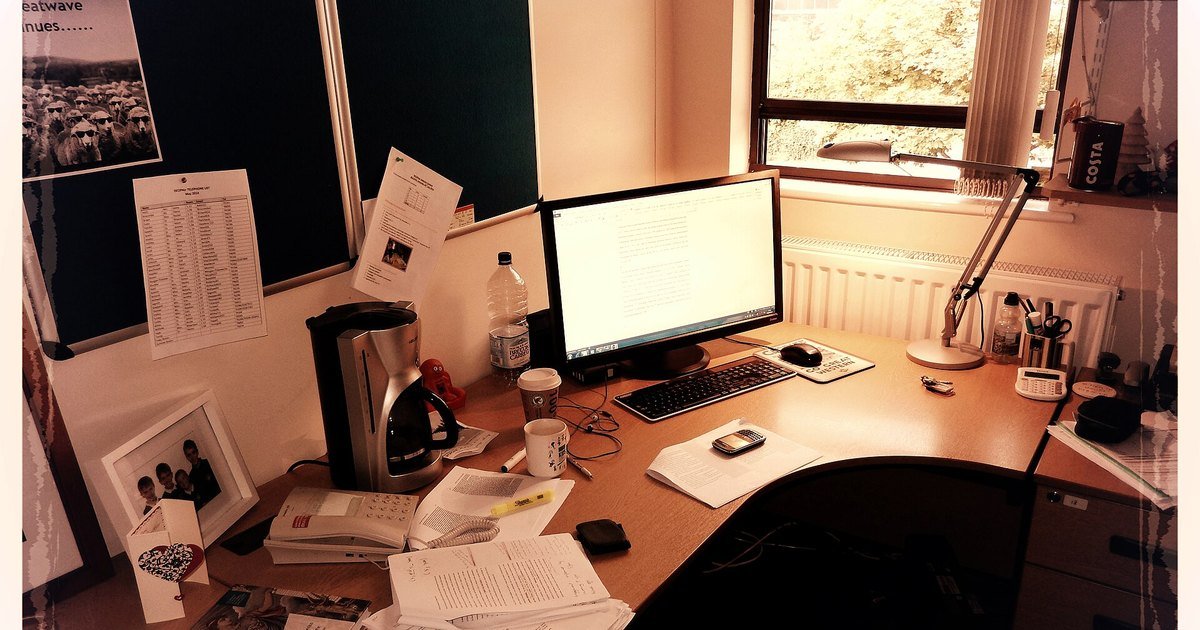
Desk work does not automatically ruin your posture, but hours in one position can leave your neck, shoulders and lower back feeling stiff and tired by the end of the day. The fix is less about holding a perfect pose and more about changing position often, setting up your workstation sensibly, and building a little strength and movement into your routine. This is general information, not medical advice, so check with a health professional about your own situation.
Photo: Wikimedia Commons (CC BY 4.0)
What posture actually is
Posture is simply how you hold your body, whether you are moving or still. The medlineplus.gov guide to good posture explains that it keeps the natural curves of your spine without exaggerating them, with your head above your shoulders and your shoulders over your hips. It also notes that slouching and slumping can contribute to neck, shoulder and back discomfort, and can affect how well your joints move. What that guidance does not say is that there is one perfect position worth holding all day. Holding any single posture for hours is usually the bigger problem, and bodies are built to change position often.
Setting up your desk
Chair
- Feet flat on the floor, or on a footrest if your chair is too high for you.
- Hips level with or slightly higher than your knees.
- Lower back gently supported, using the chair’s own curve or a small cushion.
Screen
- The top of the screen roughly at eye level, so you are not craning your neck up or dropping your chin.
- About an arm’s length away from your face.
Keyboard and mouse
- Elbows close to your body and bent to roughly a right angle.
- Wrists roughly straight rather than bent up or down.
If you want the detail behind these suggestions, Cornell University’s ergo.human.cornell.edu ergonomics resource collects research based guidance on workplace setup.
Movement beats perfect stillness
No chair setup cancels out eight hours of not moving. Stand up every half hour or so, even for a minute. Walk to refill your water bottle, take short calls standing, and vary between sitting and standing if you have that option instead of standing all day. Gentle neck and shoulder rolls, a chest opener against a doorway, and simple bodyweight strength movements all help the same cause. If your back is sore and not settling, the nhs.uk guidance on back pain sets out when it is worth seeking help.
Small habits that add up
- Take the stairs when the distance makes sense.
- Walk during phone calls that do not need a screen.
- Set a recurring reminder to stand and move.
- Walk part of your commute, or walk a loop before you start work.
None of these are dramatic. Repeated most days, they are what changes how you feel by Friday afternoon.
General information only. This is not medical advice and it is not a rehabilitation or treatment plan. If you have persistent pain, or any numbness or weakness, see a qualified health professional.
Get the basics of your setup right, then treat movement as the main tool. Change position often and your posture largely looks after itself.