
When an earthquake makes the news, the number after the word magnitude does one specific job: it describes the size of the earthquake at its source. It does not tell you how hard the ground shook where you were standing. Those are two different measurements, and confusing them is the most common mistake people make about earthquakes.
Photo: Wikimedia Commons (CC BY-SA 4.0)
What a seismometer records
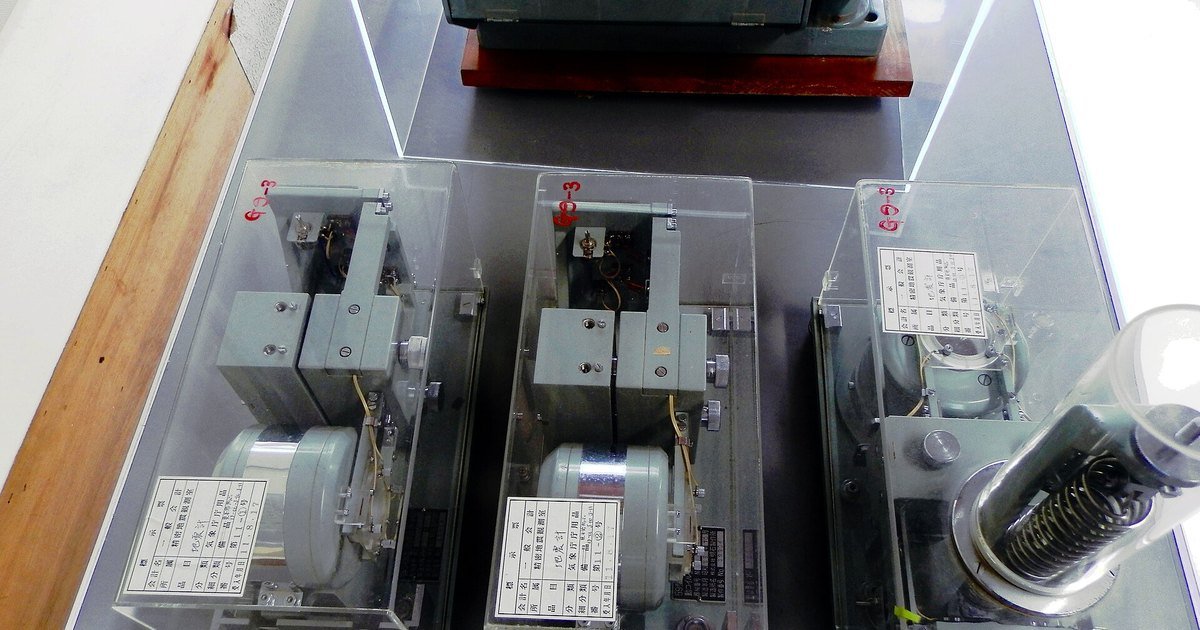
Seismometers record the vibrations from earthquakes that travel through the Earth. Each instrument records the shaking of the ground directly beneath it, and modern systems amplify and record that motion, typically at periods between 0.1 and 100 seconds. Sensitive instruments can detect strong earthquakes from anywhere in the world. The time, location and magnitude of a quake are all determined from the data recorded by networks of these instruments.
The Richter scale, and why it is rarely used now
Charles F. Richter, a seismologist at the California Institute of Technology, introduced the concept of earthquake magnitude in 1935. His original definition held only for California earthquakes occurring within 600 km of one particular type of seismograph. The idea was simple: know the distance from the instrument to the quake, observe the maximum signal amplitude, and rank the earthquake’s size. The scale is logarithmic, so each whole number increase in magnitude represents a tenfold increase in measured amplitude on a seismogram. A magnitude 5.3 is a moderate earthquake; a 6.3 is a strong one.
The local magnitude scale is not commonly used anymore, except for small earthquakes recorded locally. For everything else, the U.S. Geological Survey uses a different measure.
Moment magnitude: measuring the fault, not the trace
The moment magnitude scale starts from the physical effects of an earthquake rather than the height of a wiggle on one recording. USGS describes the seismic moment as rigidity multiplied by area multiplied by slip: the strength of the rock along the fault, the area of the fault that actually slipped, and the distance it moved. Stronger rock, a larger rupture area or more movement all produce a larger magnitude. Moment magnitude is then calculated from that moment value, which is why it stays reliable for very large earthquakes where older amplitude-based scales struggle.
Magnitude is not intensity
An earthquake has a single magnitude. The shaking it causes has many values, because it depends on distance, the type of surface material and other local factors. That location-by-location measure is called intensity. In the United States it is reported on the Modified Mercalli Intensity Scale, developed in 1931 by the seismologists Harry Wood and Frank Neumann. A few things are worth knowing about it:
- It is ranked in Roman numerals, from imperceptible shaking to catastrophic destruction.
- It has no mathematical basis, and is an arbitrary ranking based on observed effects.
- The lower numbers describe how the earthquake was felt by people; the higher numbers are based on observed structural damage.
- Structural engineers usually contribute the information used to assign the highest values.
For the full technical comparison of magnitude, energy release and shaking intensity, see usgs.gov. For the intensity scale used in the United States, see usgs.gov.
Bottom line: Magnitude answers how big the earthquake was. Intensity answers what it did where you felt it. A single earthquake has one magnitude but as many intensity values as there are places to shake.