

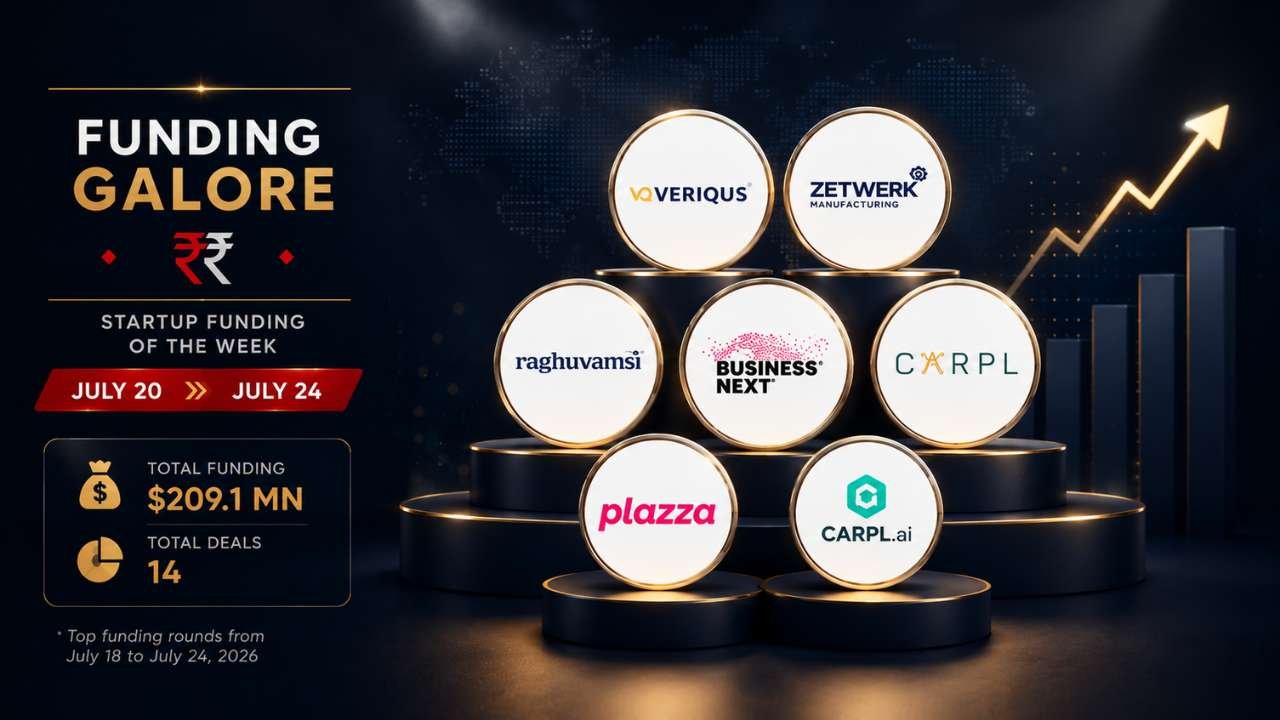
India’s startup ecosystem saw lower funding during the fourth week of July 2026, as startups raised a total of $209.1 million through 14 deals between July 18 and July 24. This was a 26% drop compared to the previous week’s $281.4 million. The number of funding deals also fell from 24 to 14.
Even though overall funding declined, the week showed a clear change in investor strategy. Instead of investing in a large number of startups, investors focused on a few well-established companies in manufacturing, aerospace, enterprise software, and wealth management. This suggests that investors are now giving more importance to businesses with strong financial performance and long-term growth.
Four Big Deals Account for Most of the Funding
More than 80% of the week’s total funding went to just four startups.
Manufacturing platform Zetwerk raised the highest amount, securing $52 million in a pre-IPO funding round. The investment valued the company at around $3 billion and will support its plans for a proposed ₹5,000 crore IPO. The company is expected to report FY26 operating revenue of nearly ₹15,900 crore and has an order book worth more than ₹12,000 crore. While Zetwerk continues to face pressure from low profit margins and debt, the fresh investment strengthens its financial position before entering the stock market.
Wealth-tech startup Veriqus Group raised $40.1 million from investors led by Norwest Venture Partners. The company was founded by experienced leaders from the financial services industry and plans to offer wealth management, lending, asset management, and business advisory services on a single platform for high-net-worth families. The company has not shared its valuation or financial details.
Enterprise banking software company BUSINESSNEXT also raised $40 million from ServiceNow Ventures. The funding increased the company’s valuation to nearly $700 million. BUSINESSNEXT provides software solutions to more than 120 financial institutions and will use the new capital to improve its AI-powered banking products and expand into Australia and New Zealand.
Hyderabad-based Raghu Vamsi Aerospace Group completed the list of major fundraisers after raising $40 million. The company supplies precision engineering products to global aerospace companies and plans to use the investment to expand its manufacturing operations in India, the UK, and the US. It also aims to speed up the development of drone and missile technologies.
Small Startups Raise Less Money as AI Funding Slows
Apart from the four biggest deals, the remaining startups shared only about $37 million, showing that investors were more careful while funding early-stage companies.
Quick-commerce startup Plazza raised $15 million in its Series A round, making it the largest funding deal outside the top four. Healthcare imaging platform CARPL.ai secured $10 million to expand its medical imaging technology, while travel discovery startup 30 Sundays raised $6.7 million.
Climate-tech startup Farm Watt received $3.3 million, followed by Bioscan Research, which raised $1 million in a seed round. Smaller investments also went to LNGVTY and NeuralKart. SolarSquare and Khageshvara Aviation Technology also announced new funding but did not reveal the investment amounts.
One of the biggest changes this week was the sharp fall in artificial intelligence funding. Just a week earlier, AI startups had received nearly 60% of all startup investments in India. However, this week only one AI startup, FireAI, raised fresh funding, securing $259,000 in a seed round. This shows that investors are currently giving more attention to sectors such as manufacturing, deeptech, and enterprise businesses.
IPO Plans and Government Support Keep Market Positive
While private startup funding slowed, activity in the public market remained strong.
Electric vehicle company Ather Energy raised around ₹1,300 crore through a qualified institutional placement as part of its larger ₹2,500 crore fundraising plan. The money will be used for debt repayment, research and development, and marketing.
At the same time, adtech unicorn InMobi moved closer to its expected public listing by appointing investment banks for its proposed $1 billion IPO. Edtech company Klassroom also announced the price band for its SME IPO. Venture capital firm Transition VC launched its second fund with a target corpus of ₹1,500 crore to invest in deeptech, advanced manufacturing, and energy transition startups. Fintech SaaS company Zaggle also approved an investment in digital banking platform Unobanc.
Overall, startup funding in July 2026 is expected to reach around $820 million, much lower than the $1.91 billion recorded in June. Although funding has slowed, investors are choosing businesses with stronger financial performance and long-term growth potential.
The government also announced two important policy measures. It approved 100% foreign direct investment (FDI) in inventory-based e-commerce models meant for exports and revamped the ₹10,000 crore Startup India Fund of Funds. The updated fund will mainly support deeptech, manufacturing, and startups from Tier-2 and Tier-3 cities.
The funding trend seen this week suggests that India’s startup ecosystem is becoming more selective. Instead of chasing fast growth, investors are now focusing on startups with strong business models, stable revenue, and clear plans for long-term success.