

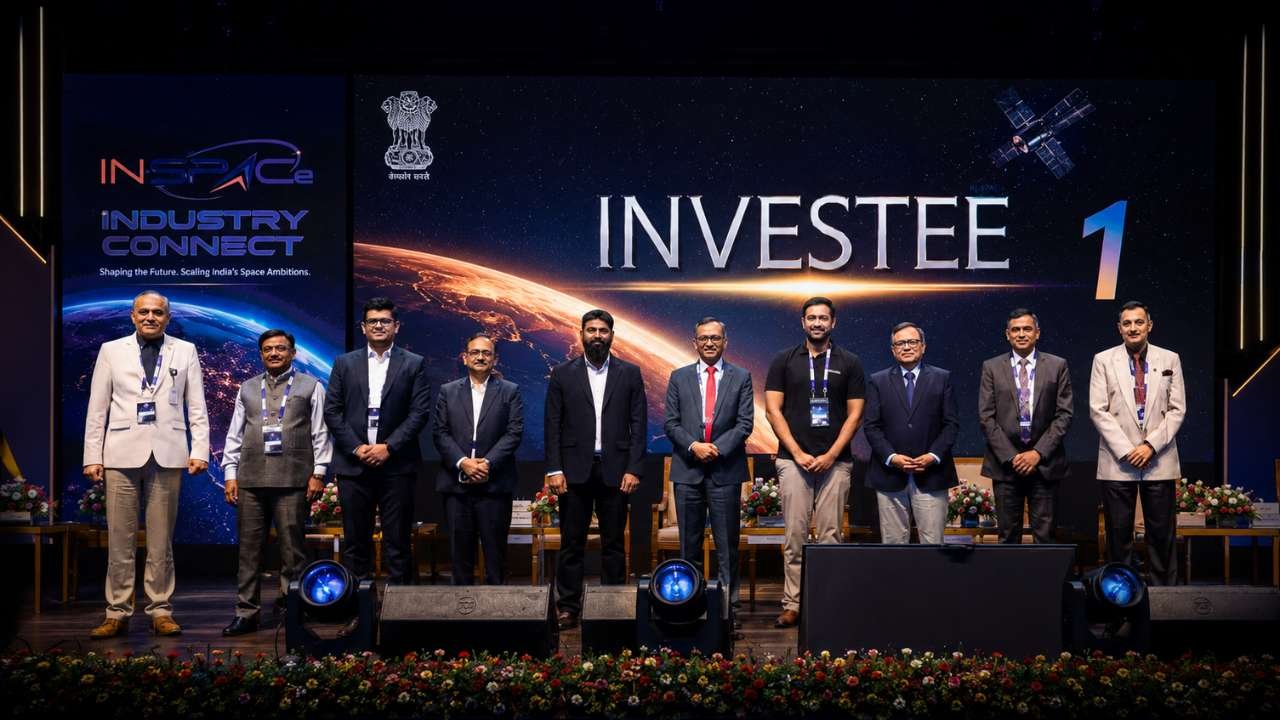
India’s private space sector has received a major boost as the Centre-backed Antariksh Venture Capital (VC) Fund made its first investment in Hyderabad-based startup Dhruva Space. The company has received ₹60 crore, marking the first investment under the government’s dedicated space startup fund.
The move is part of the Centre’s larger plan to strengthen India’s private space industry and increase the country’s share in the global space economy from around 2% to 8% by 2033. The government aims to build a space economy worth nearly $44 billion over the next decade.
Antariksh VC Fund To Support India’s Growing Space Startup Ecosystem
The Antariksh Venture Capital Fund was approved by the Union Cabinet under Prime Minister Narendra Modi to encourage innovation and growth in India’s private space sector. The fund is anchored by the Indian National Space Promotion and Authorization Center (IN-SPACe) and managed by SIDBI Venture Capital Limited (SVCL). It is registered with the Securities and Exchange Board of India (SEBI) as a Category II Alternative Investment Fund (AIF) with a 10-year tenure.
Although the fund has a target size of ₹1,600 crore, it completed its first close in November 2025 with committed capital of ₹1,005 crore. The money will be invested over five years in selected startups.
The fund plans to support around 40 Indian space startups that have reached Technology Readiness Level (TRL) 4 or above. Growth-stage startups can receive investments between ₹10 crore and ₹30 crore, while late-growth-stage companies can receive ₹30 crore to ₹60 crore.
According to officials, four startup proposals have already reached an advanced stage after receiving approval from the Pre-Investment Committee. SVCL is also helping these startups complete the required due diligence and documentation before the investments are finalised.
Dhruva Space Strengthens Growth With Fresh Government Backing
Founded in 2012 by Sanjay Nekkanti, Chaitanya Dora Surapureddy, Abhay Egoor and Krishna Teja Penamakuru, Dhruva Space has become one of India’s leading full-stack space engineering companies.
With the latest ₹60 crore investment, the company’s ongoing pre-Series B funding round has reached ₹275 crore. This includes ₹150 crore in equity and ₹125 crore in debt. Earlier, in April 2024, Dhruva Space had raised ₹123 crore in its Series A funding round, which included venture debt from SIDBI and the Technology Development Board.
The company has seen strong business growth over the past few years. Its revenue increased from just ₹15 lakh in FY20 to ₹13.5 crore in FY24. It now has an order book worth more than ₹500 crore from customers in India and overseas. Dhruva Space expects its revenue to reach ₹120 crore by FY26 and has set a target of ₹1,000 crore by FY28.
Apart from venture funding, the startup also received a ₹105 crore grant under the government’s Research, Development and Innovation Fund (RDIF) for Project Garud. The project aims to build an indigenous flat-pack 500 kg-class communication satellite platform that can be used for large satellite constellations. The design will help speed up production and could allow the company to manufacture up to two satellites every day.
To support its expansion, Dhruva Space is building a 280,000-square-foot spacecraft manufacturing facility across 6.5 acres in Shamshabad, Telangana. The first phase of the project will cover 120,000 square feet.
The company has also expanded its services by launching AstraView, a satellite imagery platform that provides Earth observation data. It has signed an agreement with French company Kinéis to manufacture satellite communication ground terminals. Dhruva Space is also part of a consortium selected by IN-SPACe to build and operate a 12-satellite Earth observation constellation worth more than ₹1,200 crore.
Government Continues To Invest In Deep-Tech Innovation
The Centre is also supporting innovation beyond the space sector through the ₹1 trillion Research, Development and Innovation (RDI) Fund.
As part of its first set of projects, EndureAir Systems received ₹30 crore to develop the SABAL-200 heavy-lift drone for defence logistics. Noccarc Robotics was selected for a ₹23 crore project to build AI-powered mobile life support systems for ambulances. Eyestem Research secured ₹125 crore to develop new cell therapies for eye diseases, while e-TRNL Energy received ₹94 crore to manufacture next-generation lithium-ion batteries.
At the same time, policy reforms are helping India’s space industry grow faster. The government has relaxed foreign direct investment (FDI) rules, introduced funding programmes such as the Technology Adoption Fund and Seed Fund, and encouraged greater private sector participation.
With the first investment now made in Dhruva Space, the Antariksh VC Fund has officially begun supporting India’s next generation of space startups. The initiative is expected to help Indian companies build advanced space technologies, expand globally, and strengthen the country’s position in the international space industry.