

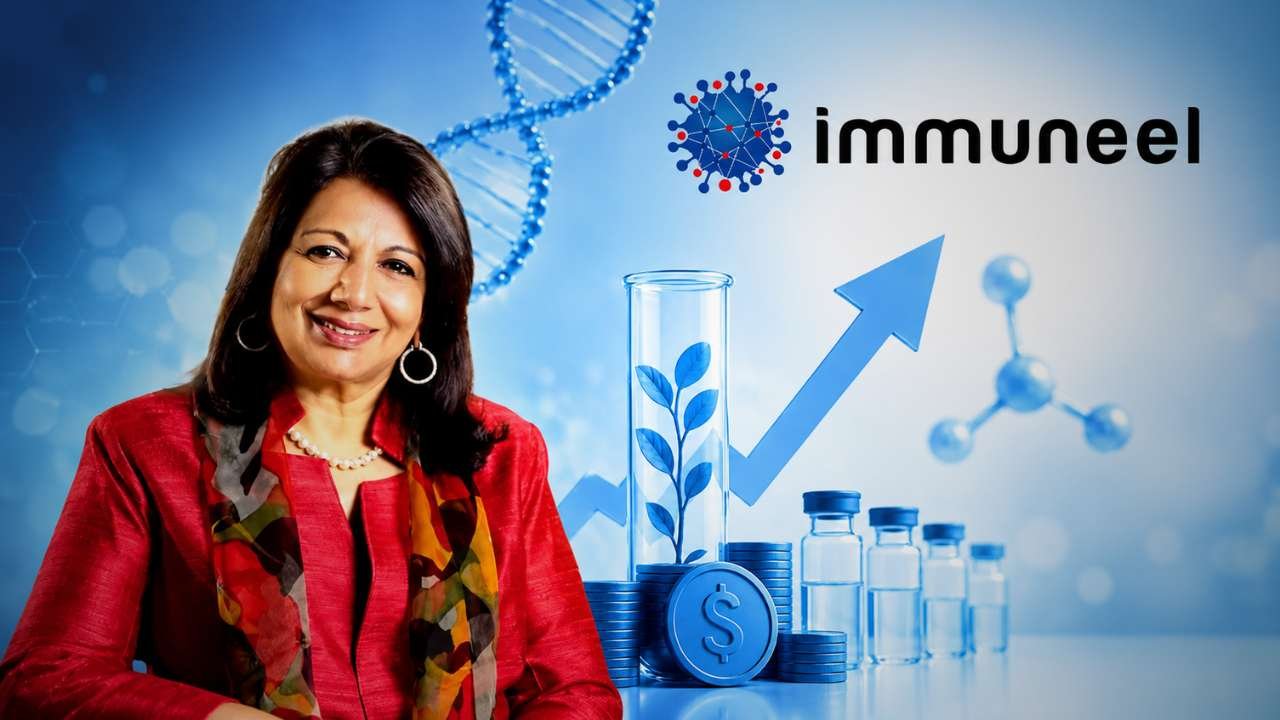
Immuneel Therapeutics, a Bengaluru-based cell and gene therapy startup, has raised more than Rs 100 crore (around $10.5 million) in a Series B funding round. The investment was led by Singularity AMC, Rainmatter by Zerodha, and several high-net-worth individuals. Existing investors, including Eight Roads Ventures and F-Prime Capital, also participated in the round.
Founded in 2018 by Biocon founder Kiran Mazumdar-Shaw, cancer specialist Dr. Siddhartha Mukherjee, and investor Kush Parmar, Immuneel is focused on making advanced cancer treatments more accessible and affordable in India. The company plans to use the fresh funds to increase its manufacturing capacity, support the growth of its CAR-T therapy Qartemi, develop next-generation treatments, and expand into Asia Pacific and Middle East markets.
Before this funding round, the startup had already raised more than $40 million from investors, including a $15 million Series A round.
Qartemi Strengthens India’s CAR-T Therapy Market
Immuneel’s flagship product, Qartemi, is one of the most important developments in India’s cancer treatment sector. It is India’s second approved CAR-T cell therapy and is used to treat adults with relapsed or refractory B-cell Non-Hodgkin Lymphoma (B-NHL), a type of blood cancer that often becomes difficult to treat after standard therapies stop working.
The treatment was originally developed in Spain and later licensed by Immuneel for use in India. After successful clinical studies, it received approval from India’s drug regulator.
Qartemi works by collecting a patient’s T-cells, modifying them in a laboratory to recognise and attack cancer cells, and then infusing them back into the patient’s body. This personalised treatment helps the immune system target cancer more effectively.
The company has already treated more than 100 patients commercially, showing growing acceptance among doctors and hospitals across the country.
Clinical Trial Results Show Promising Outcomes
The approval of Qartemi was based on results from the Phase 2 IMAGINE trial, which was conducted at several leading hospitals in India, including Narayana Health, Apollo Cancer Hospital, PGIMER Chandigarh, CMC Vellore, and Rajiv Gandhi Cancer Institute and Research Centre in New Delhi.
The study delivered encouraging results. Qartemi recorded an overall response rate of 83.3% within 90 days of treatment and maintained a 50% response rate after one year. The therapy also achieved a complete response rate of 83%, meaning many patients showed no detectable signs of cancer after treatment.
A major milestone from the study was that seven patients treated in 2022 remained progression-free for more than two years. This is one of the longest survival achievements reported for an Indian CAR-T therapy so far.
CAR-T therapies are known to carry risks such as Cytokine Release Syndrome (CRS) and neurological side effects. However, Qartemi showed a favourable safety profile during the trial. No severe neurotoxicity cases were reported, and no patients required ICU admission due to treatment-related complications.
To improve patient safety, the treatment is given in three separate doses instead of a single infusion, allowing doctors to monitor patients more closely.
Company Focuses on Expansion and Better Patient Access
Immuneel currently manufactures Qartemi at its 12,000-square-foot Good Manufacturing Practice (GMP) facility in Bengaluru. The company says the therapy can be produced within a median time of 12 days and has achieved a 100% manufacturing success rate.
At present, the facility can support treatment for around 300 to 500 patients every year. Immuneel plans to expand this capacity to nearly 1,000 patients annually as demand grows.
One of the biggest advantages of Qartemi is its lower cost compared to international CAR-T therapies. While similar treatments abroad can cost between Rs 3 crore and Rs 4 crore, Qartemi is priced between Rs 35 lakh and Rs 50 lakh, making it significantly more affordable for Indian patients.
Even so, the treatment remains expensive for many families because health insurance coverage for CAR-T therapy is still limited in India. To help patients manage costs, Immuneel has partnered with healthcare financing platform CarePal Money and medical crowdfunding platform Impact Guru. These partnerships provide financing options and fundraising support for eligible patients.
The company has also expanded its network of partner hospitals across India, including Narayana Health, Apollo Hospitals, Manipal Hospitals, CMC, SGPGI Lucknow, Amrita Hospital, Cytecare, and several other cancer care centres.
With fresh funding, growing clinical success, and expanding hospital partnerships, Immuneel is looking to play a larger role in India’s advanced cancer treatment market while improving access to life-saving therapies for patients across the country.