

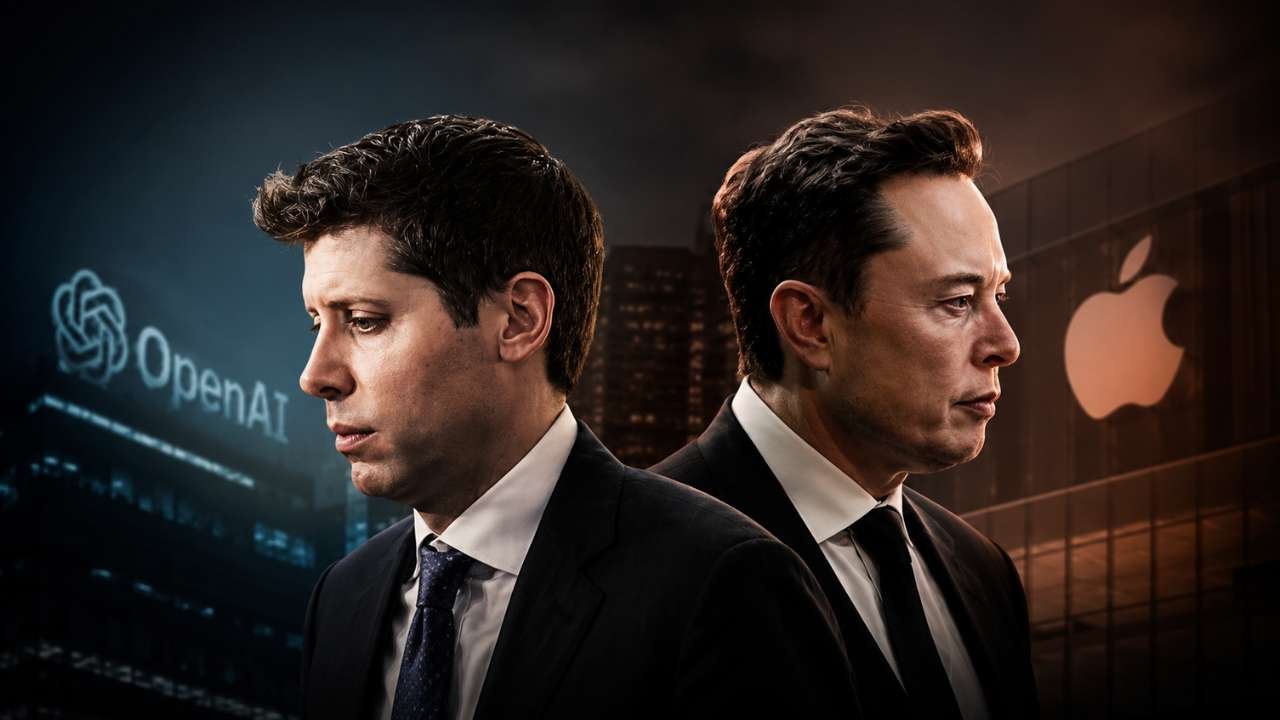
The competition in the artificial intelligence (AI) industry has taken a dramatic turn after Apple filed a major trade secret lawsuit against OpenAI. The case has not only raised questions about OpenAI’s future hardware plans but has also restarted the public feud between OpenAI CEO Sam Altman and Tesla and xAI chief Elon Musk.
Apple filed the lawsuit in the US District Court for the Northern District of California on July 10. The company has accused OpenAI, former Apple executives Tang Tan and Chang Liu, and io Products of using Apple’s confidential hardware technology without permission. Apple claims the company took shortcuts while building its AI hardware business. OpenAI has denied the allegations, and the case will now be decided in court. At this stage, none of Apple’s claims have been proven.
Apple questions OpenAI’s AI hardware development
In its lawsuit, Apple says OpenAI built its hardware division using confidential information from former Apple employees. The company claims Tang Tan, who spent 24 years at Apple before joining OpenAI as Chief Hardware Officer, encouraged Apple employees to discuss internal projects during job interviews.
Apple also alleges that former engineer Chang Liu did not return his company laptop and accessed Apple’s internal systems after leaving the company. The lawsuit further claims that OpenAI employees tried to keep access to Apple’s network during their notice period and contacted Apple’s manufacturing partners using knowledge of Apple’s own production methods.
The legal case also focuses on io Products, the startup founded by former Apple design chief Jony Ive along with Tang Tan, Evans Hankey and Scott Cannon. OpenAI later bought the company in a deal worth around $6.5 billion. The acquisition is seen as a key step in OpenAI’s plan to move beyond AI software and enter the consumer hardware market.
Reports suggest OpenAI is working on several AI-powered devices. These include a smart speaker with a camera, a wearable device called “Sweetpea”, a pen-shaped gadget named “Gumdrop” for recording notes, and an AI smartphone planned for the coming years. None of these products have been officially launched yet. However, if Apple wins the lawsuit, OpenAI could be forced to redesign some of its future hardware.
Sam Altman responds after Elon Musk attacks OpenAI
Soon after Apple’s lawsuit became public, Elon Musk criticised Sam Altman on X, calling him “Scam Altman” and accusing him of using Apple’s technology.
Altman responded after OpenAI launched its new GPT-5.6 model. He joked that the biggest sign the model was performing well was that “Elon is obsessed with me again.” The exchange quickly became another chapter in the long-running rivalry between the two AI leaders.
Their disagreement is not limited to legal issues. Altman also questioned Musk’s idea of building space-based data centres, saying that large AI data centres on Earth are a more practical solution for the growing demand for computing power. Musk, on the other hand, continues to support the idea of using space technology for future AI infrastructure.
The latest social media exchange came only weeks after Musk lost another legal battle against OpenAI over the company’s direction. Although that case is separate from Apple’s lawsuit, the new allegations have added more tension to the ongoing conflict between the two technology billionaires.
Lawsuit creates uncertainty around OpenAI’s future plans
Even with the legal challenges, OpenAI remains one of the world’s biggest AI companies. The company has attracted huge investments and continues to grow its AI products for consumers and businesses.
However, experts believe the Apple lawsuit could affect OpenAI’s hardware plans and its expected IPO. Apple is asking the court for a jury trial, the return of any confidential information, and an order that could stop or delay products if they are found to use Apple’s intellectual property.
The lawsuit also comes at a time when several senior OpenAI executives have reportedly left the company. While leadership changes are common in fast-growing technology firms, some analysts believe the combination of legal problems and executive departures could make investors more cautious before the company’s public listing.
For now, the Apple vs OpenAI lawsuit has become one of the biggest legal battles in the AI industry. The final court decision could influence how technology companies protect trade secrets, hire employees from competitors, and develop future AI hardware. As both companies prepare for a long legal fight, the case is likely to shape the future of the global AI industry.