

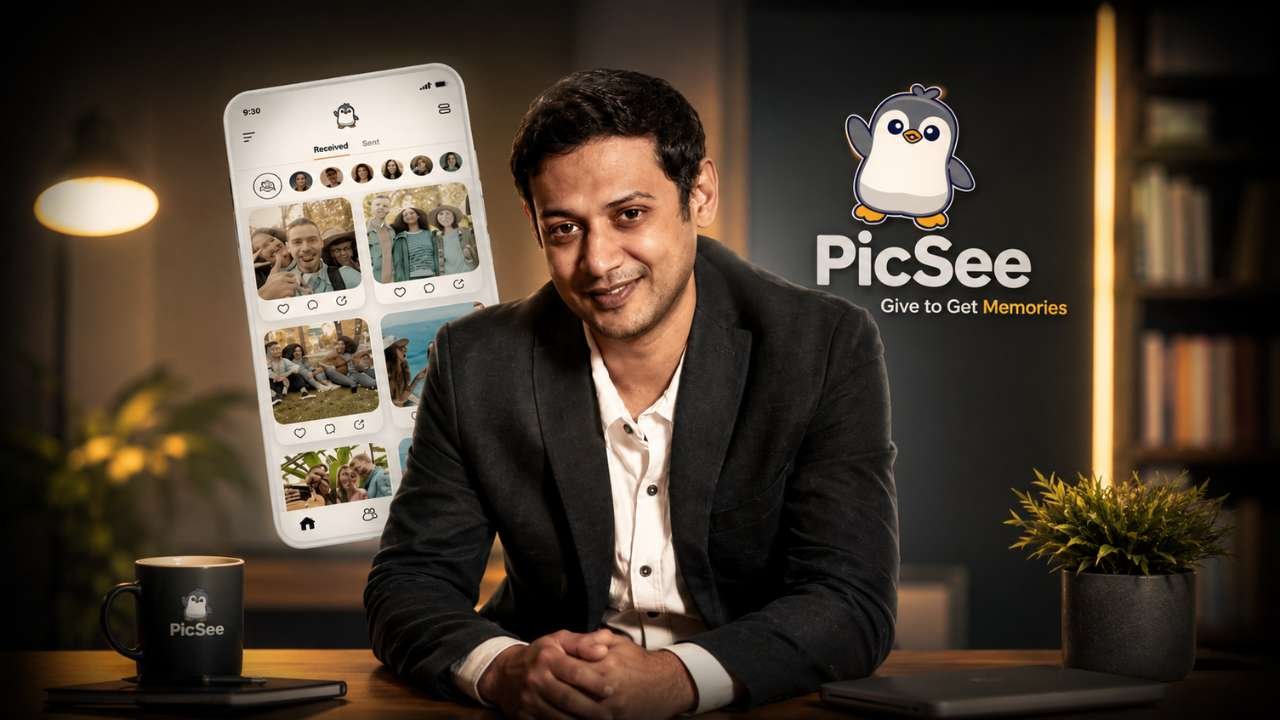
Artificial intelligence (AI)-powered photo-sharing startup PicSee has shut down less than a year after its public launch. The startup was founded by Koo co-founder Mayank Bidawatka and former Koo executive Sarthak Gupta. Instead of spending its remaining money on trying a new business idea, the founders have decided to return most of the unused investment to their investors, a move that is rarely seen in the startup world.
PicSee was the main product of Billion Hearts Software Technologies Private Limited, a Bengaluru-based consumer tech startup launched in 2024. The company was created to solve a common problem faced by smartphone users—people often never receive photos that their friends click during trips, parties, weddings or family events.
The startup quickly gained investor interest. It first raised $250,000 in a pre-seed funding round from well-known angel investors. Later, it secured another $4 million in seed funding from leading venture capital firms. Overall, PicSee raised $4.25 million while running with a small team of around 11 to 14 employees and offices listed in Bengaluru, San Francisco and Singapore.
PicSee Wanted to Help People Get Their Missing Photos
PicSee described itself as the world’s first AI-powered mutual photo-sharing app. The company focused on solving what it called “photo debt”—the huge number of photos that stay on friends’ phones and never reach the people who appear in them.
The app used a simple “give-to-get” system. Users could receive photos of themselves only if they agreed to share the photos they had taken of their friends. This encouraged everyone in a group to contribute their pictures.
PicSee used on-device AI and facial recognition technology to scan users’ photo galleries, identify friends and match photos automatically. This removed the need for manual uploads or tagging.
Privacy was one of the company’s biggest priorities. Photos were not permanently stored on cloud servers. They stayed on users’ devices and were protected with end-to-end encryption during transfer.
The app also included several safety features. It blocked screenshots, automatically filtered sensitive content such as nudity and intimate moments, and gave users 24 hours to review photos before they were shared. Even after sending photos, users could use a recall feature to remove access if they shared something by mistake. For iPhone users, the app could also fetch missing photos from iCloud if enough storage space was available on the device.
Good User Growth Could Not Solve the Bigger Challenge
PicSee had a positive start after launching. It first began with only 25 users during its soft launch in July 2025 before officially launching in October 2025. In less than three months, the app expanded to users in 27 countries and more than 160 cities, mainly through word-of-mouth recommendations.
The company said more than 150,000 photos were exchanged through the app. It also claimed that nearly 30% of users ended up having more photos of themselves on PicSee than in their own phone galleries.
As the platform grew, PicSee introduced new features like video sharing, sorting received photos by date and manually tagging friends who were missing from an exchange. The founders also planned to add AI photo and video editing tools, smart albums, storage-saving features and eventually build a private social network for close friends and families.
However, despite building a product that users liked, the company faced one major problem. Social apps become useful only when a person’s entire friend group joins the platform.
While attracting individual users was easy, convincing complete friend circles to sign up was much harder. The company also tried digital advertising, but it brought in users who were not active enough. As a result, the cost of getting new users became too high, making it difficult for the business to grow.
Founders Decide to Return Investor Money
After reviewing the business, the founders decided that although the product worked well, it had not achieved the product-market fit needed to build a large and sustainable company.
Instead of using the remaining money on risky expansion plans or new business ideas, they chose to protect the unused capital. PicSee announced that it will return around 60% to 65% of the money it raised—about $2.4 million to $2.6 million—to its investors. Such a decision is uncommon in the Indian startup ecosystem, where companies usually continue trying new strategies before shutting down.
Before closing the platform, PicSee released its final app update. The update allows users to download and save all the photos and videos they received through the app before the servers are switched off. It also included a farewell message from the company’s penguin mascot.
Although PicSee’s journey has come to an end, the startup showed that it is possible to build AI-powered products with a strong focus on user privacy. Its decision to return unused investor money instead of spending it on uncertain plans also makes its shutdown different from many other startup closures in India.