

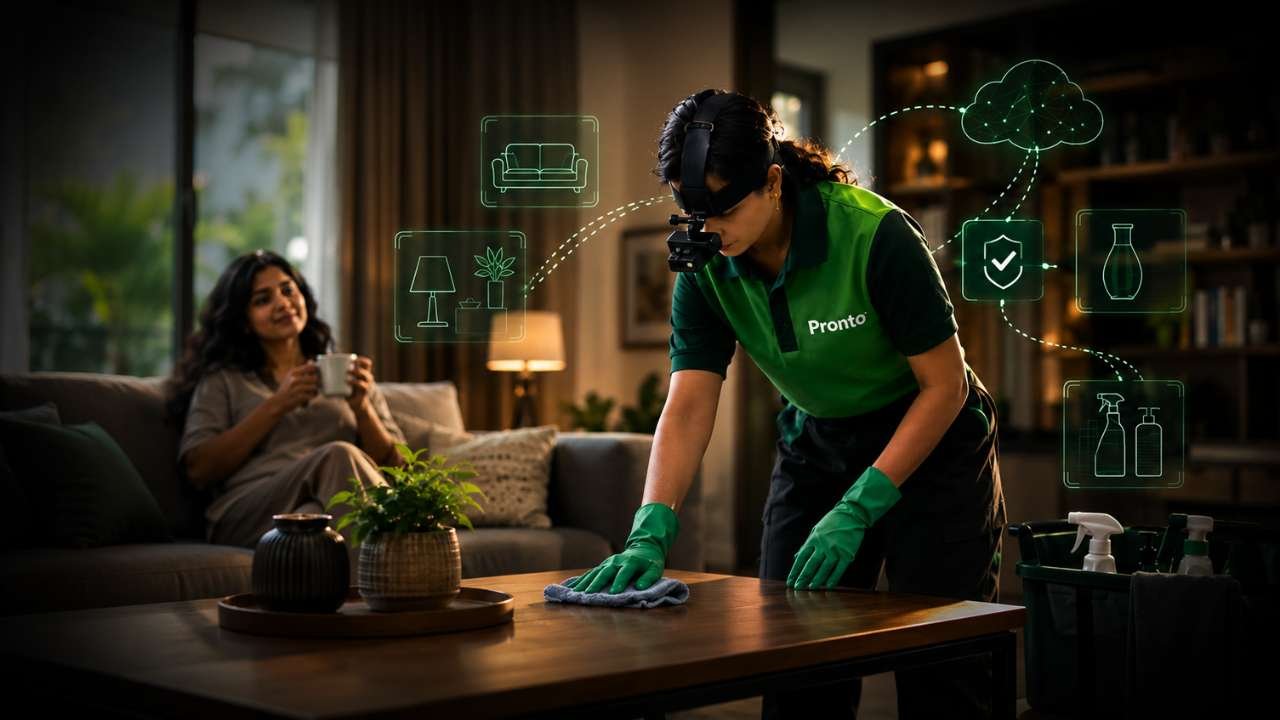
Home services startup Pronto has expanded its AI-based camera program inside customers’ homes through its new “Pronto Verified” service. The company says the feature will improve service quality and help develop AI systems for future robots. However, the move has also raised questions about privacy, workers’ rights, and the future of domestic jobs in India.
Pronto was founded in April 2024 by Anjali Sardana. The startup offers household services such as cleaning, dishwashing, laundry, and kitchen preparation. Its main promise is to send a trained and verified professional to a customer’s home in about 10 minutes.
Pronto grows fast with its 10-minute home service model
Pronto works like a quick-commerce platform for home services. It has small local hubs that cover areas within a 3 km radius, allowing workers to reach customers quickly.
Unlike many gig platforms, Pronto hires its workers for fixed shifts instead of assigning jobs one by one. This gives workers a more stable income and regular working hours.
The company says it has 872 active professionals, and around 99% of them are women. On average, each worker completes about seven jobs every day and earns between ₹23,000 and ₹25,000 per month. Pronto also says it has a monthly worker retention rate of more than 70%.
The startup has grown rapidly over the past year. Daily bookings increased from around 1,000 in August 2025 to nearly 18,000 by March 2026. About half of these bookings come from Delhi NCR, while Bengaluru, Mumbai, and Pune also contribute a large share. Customers usually spend between ₹200 and ₹300 per booking, and Pronto earns a commission of 20% to 25%.
The company has also raised significant funding from investors. Its latest funding round brought in another $20 million and doubled the company’s valuation to $200 million.
As part of its expansion, Pronto launched “Pronto Verified.” This is an optional service where customers can choose to have their cleaning session recorded by paying an extra fee. The additional charge starts from ₹25 for a 30-minute session and goes up to ₹119 for a 90-minute session.
For this service, the worker wears a small camera on the forehead. The camera records only the hands, arms, and the work being done, such as washing dishes or folding clothes. It does not record audio. Pronto says customers can watch the recording for up to 48 hours before it is permanently deleted.
Workers who take part in the pilot program are currently earning double their normal pay. The company says this could increase to three times their regular earnings in the future.
Privacy concerns grow over AI recording inside homes
Even though joining Pronto Verified is optional for both customers and workers, the service has raised concerns among privacy experts.
Pronto says all videos are encrypted on the device. It also says faces and other personal details are automatically blurred, and the original recordings are deleted within 48 hours.
However, experts believe deleting the video does not completely solve the problem. They say once the footage is used to train an AI model, the information becomes part of the system. Even if the original recording is deleted later, it is very difficult for the AI to remove what it has already learned.
Some experts have also questioned whether workers are giving their consent freely. They argue that offering higher pay to low-income workers could influence their decision to join the program. They believe the knowledge collected from workers today could eventually help build robots that may replace similar jobs in the future.
Another concern is the privacy of other people inside the house. Family members, children, guests, or visitors could appear in the recordings even though they never agreed to be recorded.
The rollout has also led to reactions from other companies in the home services industry. Some competitors have clearly said they do not plan to use wearable cameras inside customers’ homes.
What this means for AI and jobs in India
Pronto says the recordings will help create real-world data needed to train physical AI systems. Unlike computer-generated simulations, first-person videos show exactly how people perform everyday household tasks, making them more useful for teaching robots.
The company believes this data will support the development of future AI-powered robots that can carry out physical work more effectively.
At the same time, the initiative has started a bigger conversation about the future of jobs in India. Experts say AI is expected to create new opportunities, but it could also replace many existing jobs. This makes skill development and training more important than ever.
India already faces challenges in providing technical and vocational training to a large part of its workforce. As AI continues to grow across different industries, experts believe workers will need new skills to stay ready for future jobs.
For now, Pronto’s AI camera program is more than just a new service feature. It has become an example of the difficult balance between innovation, privacy, worker rights, and the responsible use of AI. As technology becomes a bigger part of everyday life, these discussions are expected to become even more important.