

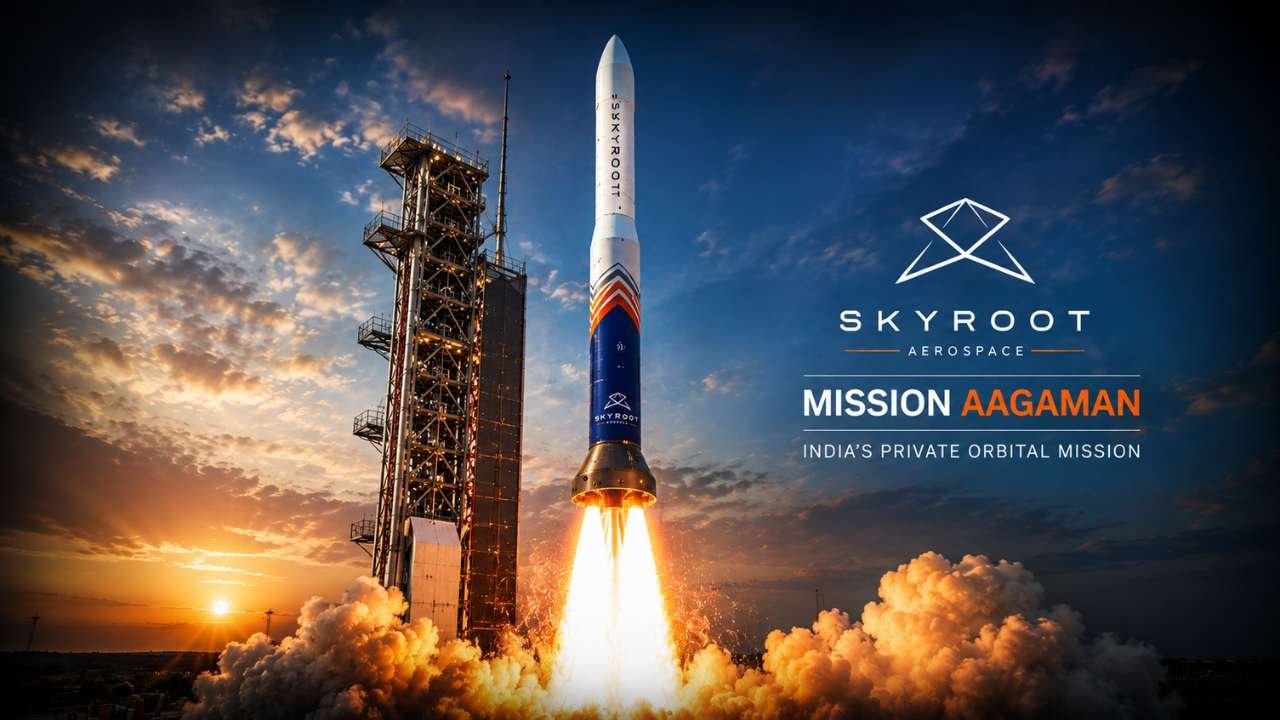
India has achieved a major milestone in space exploration as Hyderabad-based Skyroot Aerospace successfully launched its first orbital rocket, Vikram-1, on July 18, 2026. With this mission, called Mission Aagaman, India has become the third country in the world after the United States and China to have private orbital launch capability.
The successful launch marks a big moment for India’s private space sector. It shows that Indian startups are now capable of building and launching advanced rockets, something that was once done only by government space agencies. The achievement also reflects how recent space sector reforms are helping private companies grow in India.
Vikram-1 Successfully Places Payloads into Orbit
Vikram-1 lifted off from the First Launch Pad at the Satish Dhawan Space Centre in Sriharikota at 12:05 PM IST. The launch was delayed by about 35 minutes because engineers carried out a planned check after noticing a navigation-related issue. Once everything was confirmed to be safe, the rocket took off successfully.
About 17 minutes after liftoff, Skyroot announced that the mission was a complete success. The rocket reached its planned Low Earth Orbit at an altitude of 450 kilometres with a 60-degree inclination and successfully placed all its payloads into orbit.
Prime Minister Narendra Modi congratulated the Skyroot team after the successful mission. He called it a historic achievement and said it showed India’s growing strength in innovation and entrepreneurship.
Vikram-1 has been built for the fast-growing small satellite market. The four-stage rocket is about seven storeys tall and can carry payloads weighing up to 350 kilograms to Low Earth Orbit.
The rocket has been made using lightweight carbon fibre composite materials instead of traditional metal, making it both strong and light. It is also protected by a special cork-based thermal layer that helps it withstand the extreme heat during launch.
For propulsion, Vikram-1 uses solid-fuel boosters along with a 3D-printed liquid cryogenic engine. Its guidance, navigation and control systems run on real-time software developed in C and C++, while mission data is sent back to ground stations through secure S-band communication.
Another major highlight is that the rocket was built using a completely Indian supply chain involving nearly 400 suppliers across the country.
Mission Carried Technology and Special Symbolic Payloads
Since Mission Aagaman was Vikram-1’s first orbital flight, it mainly carried technology demonstration payloads instead of expensive commercial satellites.
One of the main payloads was Embrace, a robotic arm developed by Indian company Cosmoserve Space. The technology is designed to capture space debris in future missions.
Skyroot also launched its own satellite called SCOPE, which collected important flight data to help engineers study the rocket’s performance.
The mission also carried SOLARAS S3, a nanosatellite pathfinder developed by Indian startup Grahaa Space, along with a technology demonstration payload from German company DCUBED.
Apart from technology, the rocket also carried several symbolic items. These included Cosmic Bloom, a floral artwork made using lab-grown gems, and an 18-karat gold micro-rocket containing tiny sculptures of famous Indian scientists Sir C.V. Raman, Dr. Vikram Sarabhai and Dr. A.P.J. Abdul Kalam.
Adding an emotional touch to the mission, handwritten postcards from Prime Minister Narendra Modi carrying the message “Vande Mataram” were also sent into space along with postcards written by Indian scientists, astronauts and engineers.
These payloads celebrated both India’s scientific achievements and its cultural pride.
Skyroot Eyes Commercial Launches After Historic Success
Skyroot Aerospace was founded in 2018 by former ISRO scientists Pawan Kumar Chandana and Naga Bharath Daka. In a short time, the company has become one of India’s leading private space startups.
The company recently became a unicorn after raising $60 million in a new funding round, taking its valuation to around $1.1 billion. Overall, Skyroot has raised nearly $160 million so far.
The company operates from its 100-acre Infinity Campus in Hyderabad and plans to begin commercial launch services in 2027. Its goal is to offer dedicated launches for small satellites through what it calls a “cab service to space” model. While launch services have not yet started commercially, Skyroot’s space systems manufacturing business has already started earning revenue.
Skyroot has ambitious plans for the future, aiming to grow its revenue and expand its workforce over the next few years. It has also partnered with international launch companies to attract customers from around the world.
The success of Mission Aagaman also highlights the positive impact of India’s space reforms, including the Indian Space Policy 2023 and relaxed foreign investment rules. These changes have helped India’s private space ecosystem grow from just one startup in 2014 to more than 400 space startups today.
However, industry experts say challenges still remain. India’s domestic demand for private satellite launches is currently limited, so companies like Skyroot will need to win international launch contracts and defence-related projects to maintain regular launches.
Even with these challenges, Vikram-1’s successful mission is a major achievement for both Skyroot Aerospace and India’s private space industry. It proves that Indian companies now have the capability to design, build and launch orbital rockets, opening a new chapter for the country’s growing role in the global space sector.