

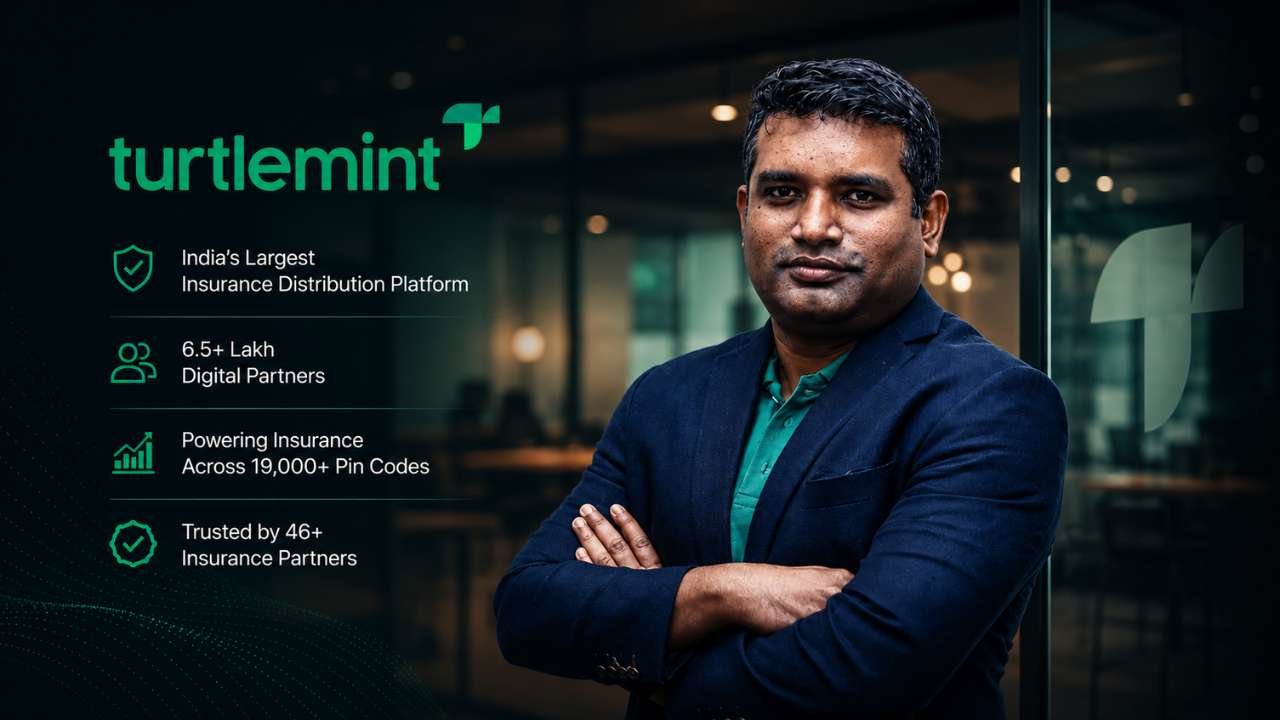
Insurance distribution platform Turtlemint has reported its first-ever quarterly profit, marking an important milestone for the company. In the fourth quarter (Q4) of FY26, it posted a net profit of ₹3.12 crore, compared to a net loss of ₹39.4 crore in the same period last year.
The company also recorded strong business growth during the financial year. Its consolidated revenue from operations increased 57% year-on-year to ₹1,098.3 crore in FY26. The performance shows that Turtlemint is recovering well after facing major regulatory challenges over the past two years.
However, despite reporting a profitable quarter, the company is still loss-making for the full financial year and continues to face challenges such as cash flow pressure, competition, and regulatory risks.
Revenue Growth Driven by Strong Insurance Business
Turtlemint follows a “phygital” business model, which combines digital technology with a large network of local insurance advisors. Through its platforms like Turtlemint Pro, the Consumer app, and Turtlefin, the company helps customers buy and manage insurance while supporting insurance advisors and business partners.
During FY26, Turtlemint’s revenue from operations grew to ₹1,098.3 crore from ₹700.3 crore a year earlier. In the January-March quarter alone, revenue increased 42% year-on-year to ₹357.2 crore.
The company now has more than 6.59 lakh registered digital partners, including over 5.32 lakh certified Point of Sales Persons (PoSPs). Its network covers more than 19,000 pin codes across India. Around 80% of its partners are based in towns and cities outside India’s top 30 urban markets, helping the company expand insurance services to smaller locations.
Platform premium also grew strongly during the year, rising 31% to ₹3,868 crore. Renewal commission revenue increased 51% to ₹224.6 crore, showing that more customers are renewing their insurance policies through the platform. So far, Turtlemint has helped customers buy more than 29.5 million insurance policies across life, health, motor, and general insurance.
The company also improved its operating efficiency. Service EBITDA rose 70% during FY26, while adjusted EBITDA reached breakeven in the fourth quarter. At the same time, corporate overhead costs came down from 38% of revenue in FY25 to 23% in FY26, showing better cost management.
Company Recovered After Major Regulatory Setback
Turtlemint’s recovery comes after a difficult period caused by changes in insurance regulations.
Earlier, the company earned a large part of its income from marketing fees paid by insurance companies, while commission income was handled through a separate insurance broking business. After the insurance regulator introduced new Expense of Management (EOM) rules, insurance companies reduced their marketing spending.
This caused Turtlemint’s marketing fee income to fall sharply in FY24 before dropping to zero in FY25, creating a major impact on its business.
To overcome this challenge, the parent company bought Turtlemint Insurance Broking Services in May 2024 for ₹105 crore. This brought the commission business under one company and helped rebuild its main source of revenue.
Even after strong revenue growth, Turtlemint reported a consolidated net loss of ₹184.26 crore for the full FY26. The yearly loss also included IPO-related expenses and adjustments linked to financial instruments.
The company also continued to expand its partner network. However, while more than 6.5 lakh partners are registered, only around 83,600 partners were actively selling insurance on average during FY26.
IPO Plans, AI Focus and Future Challenges
Turtlemint was listed on the stock market in June 2026 through an IPO worth ₹883 crore. The issue received a modest response from investors, and the shares were listed at a discount of more than 10% on the stock exchanges.
The company’s valuation was also lower than its earlier private funding rounds. While early investors earned strong returns by selling part of their holdings, many late-stage investors are still holding shares at lower valuations.
A large part of the IPO money will be used for technology development, cloud infrastructure, working capital, and employee costs. Turtlemint is also investing heavily in artificial intelligence (AI). The company plans to use conversational AI, AI-powered renewal calls, large language models, and AI assistants to improve productivity and support its insurance partners.
At the same time, analysts have pointed out several risks. The company pays commissions to insurance advisors immediately after a policy is sold, but receives commission payments from insurance companies over a longer period. This creates pressure on cash flow.
Turtlemint also depends heavily on general insurance, especially motor insurance, and earns a large share of its revenue from a limited number of insurance companies. High employee attrition, growing competition from large financial services companies, and possible future regulatory changes are also challenges that the company will need to manage.
Still, Turtlemint’s first profitable quarter is an important achievement. Investors will now be watching closely to see if the company can maintain steady growth, improve cash flow, and achieve full-year profitability in the coming years.