

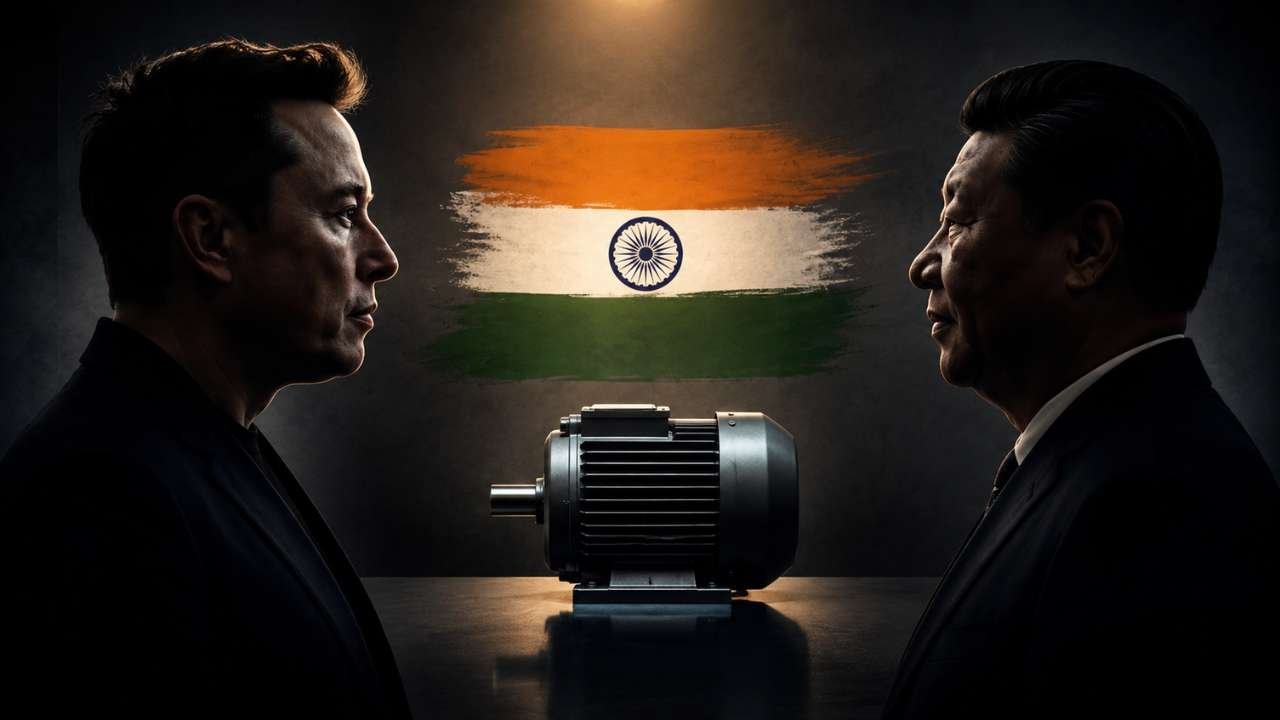
India’s electric vehicle (EV) industry may be entering a new phase as Bengaluru-based deep-tech startup Vimag Labs has developed an electric motor that works without rare-earth permanent magnets. The innovation comes at a time when the global EV industry is looking for alternatives to reduce its dependence on China’s rare-earth mineral supply.
Founded in September 2025 by Manish Seth and Piyush Desai, Vimag Labs has created what it calls the Virtual Magnet Synchronous Motor (VMSM). The company says its new motor can deliver performance similar to traditional permanent-magnet motors while removing the need for rare-earth materials.
The development has gained attention because many global automakers have been working on similar technologies for years. While several companies have announced plans to build rare-earth-free motors, Vimag says it has already developed working prototypes and secured patents for its technology.
How a Supply Chain Crisis Inspired the Innovation
The idea for the motor came during the COVID-19 pandemic. Vimag Labs CEO Manish Seth faced a major problem when a shipment of permanent magnets needed for prototype motors was stuck at a Shanghai port for nearly three months because of lockdown restrictions.
The delay showed how much the EV industry depends on a small number of suppliers for important materials. Instead of looking for another supplier, Seth decided to find a way to build an electric motor without using permanent magnets.
This led to the creation of the Virtual Magnet Synchronous Motor. Instead of using physical magnets, the motor creates its magnetic field with specially designed copper coils, advanced power electronics, and software-based control systems.
One of the key features of the motor is its patented rotating transformer excitation system. This technology transfers power wirelessly inside the motor, removing the need for brushes and slip rings. As a result, the motor is fully brushless, which can improve reliability and reduce maintenance costs.
The motor is made mainly from common materials like copper and steel. According to Vimag Labs, this design can deliver strong performance, good acceleration, high energy efficiency, and similar driving range without relying on rare-earth magnets.
The company says it spent more than 87,600 engineering hours developing the technology. It has already received its fifth Indian patent and has another ten patents and fifteen trademarks currently under process.
Funding and Production Plans
To speed up development and prepare the motor for commercial use, Vimag Labs recently raised $5 million in a Series A funding round. The investment was led by Accel, with support from Chakra Growth Fund and Singapore-based Thinkuvate.
The company plans to use the funding to expand its engineering team, improve the technology, and prepare for large-scale production.
Vimag has also signed a Memorandum of Understanding (MoU) with Jendamark, a company that designs automated assembly and testing systems for EV manufacturers. This partnership will help the startup build production lines for its new motors.
At present, the company is testing the motor with several electric two-wheeler and passenger vehicle manufacturers. It plans to produce between 1,000 and 10,000 motors by the end of this year before starting full commercial production next year.
The first customers are expected to be electric two-wheelers and three-wheelers. Later, the company plans to supply motors for passenger cars, buses, and electric trucks.
Apart from electric vehicles, Vimag is also working on larger motors between 200 kW and 600 kW for industrial use. The technology could also be used in robotics, defence equipment, and cooling systems.
Why This Technology Is Important
Today, around 94.7% of the world’s light electric vehicles use motors with rare-earth permanent magnets. China controls most of the global supply of these materials, making many automakers dependent on Chinese exports.
A successful rare-earth-free motor could reduce this dependence and help manufacturers build more secure supply chains.
The announcement has also drawn attention because Tesla and Elon Musk had earlier said they were working on a rare-earth-free electric motor. During Tesla’s Investor Day in 2023, Musk spoke about reducing the use of rare-earth materials in future EV motors. Vimag Labs now says it has already built and patented a working version of such a motor.
However, industry experts believe the real challenge is still ahead. While the technology looks promising, its performance must be proven through large-scale production and real-world use. The company’s claims about efficiency, power, and reliability have not yet been independently verified at commercial scale.
Even so, the development is an important achievement for India’s deep-tech sector. If the upcoming pilot projects are successful and the motors perform as expected, Vimag Labs could help strengthen India’s EV industry and become an important player in the global electric motor market.