
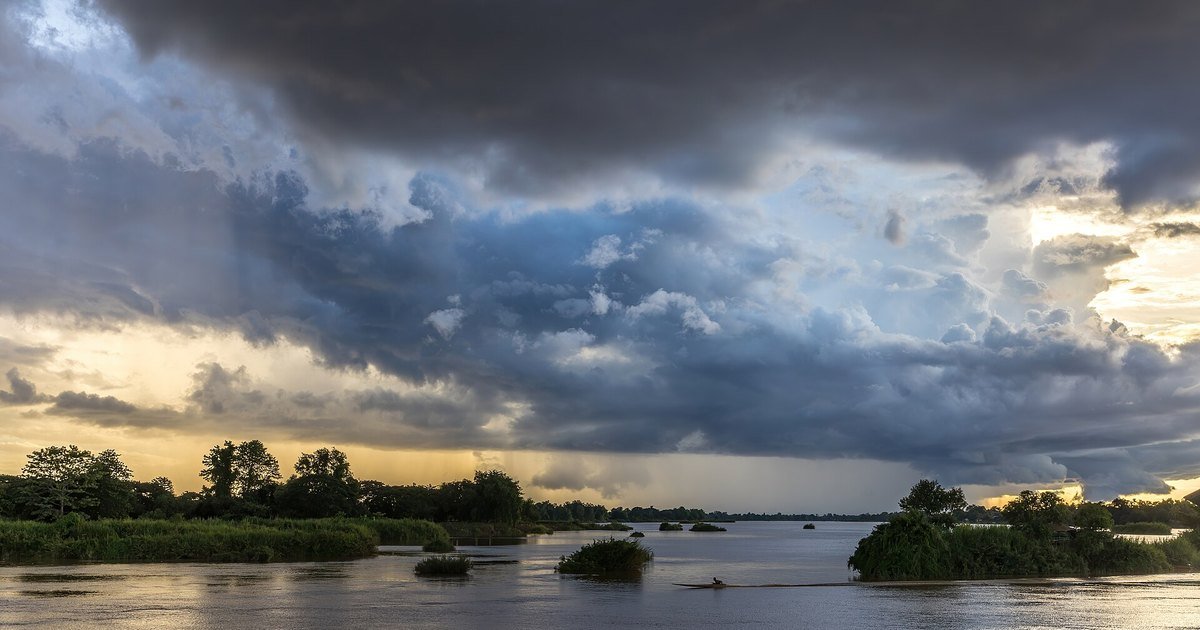
The short answer is scattering. Sunlight looks white, but it is a mixture of all the colours of the rainbow, and those colours do not behave identically when they meet air. Blue light travels as shorter, smaller waves than red light, and the gas molecules in the atmosphere are much smaller than the wavelength of visible light. That mismatch is the key: short wavelengths are redirected far more strongly than long ones. This process is called Rayleigh scattering, and it is why blue light bounces around the whole sky and reaches your eyes from every direction while red light mostly carries straight on.
Photo: Wikimedia Commons (CC BY-SA 4.0)
Why blue, and not violet
Violet light has an even shorter wavelength than blue, so it is scattered more. Yet the sky is not purple, for two reasons. Human eyes are more sensitive to blue than to violet, and there is less violet light in sunlight in the first place. The colour you see is a compromise between physics and biology.
That the colours are all there to begin with is easy to demonstrate. As Isaac Newton showed with a triangular prism, white light separates into the colours of the rainbow, which means sunlight arrives at the atmosphere carrying every wavelength at once.
Why the sky fades near the horizon
Overhead, the blue is at its most saturated. Look towards the horizon and your line of sight passes through far more atmosphere. The light is scattered and scattered again along the way, mixing in more white light, so the blue washes out into the pale band you see on a clear afternoon.
Why sunsets and sunrises turn red
At sunrise and sunset the Sun sits low in the sky, and its light has to cross a much thicker slab of atmosphere to reach you. Most of the blue has been scattered away in other directions by the time the light arrives, so the longer wavelengths – the reds and oranges – come through. Dust, pollution and other small particles add to the effect, because they also scatter blue light and leave the warmer colours to travel on to your eyes. Sometimes the whole western sky seems to glow, because the scattered light spreads well beyond the Sun itself.
A common misconception
It is often said that the sky is blue because it reflects the oceans. That is not what is happening. The colour comes from the atmosphere itself. Even over dry land, far from any coast, the sky is the same blue.
The same physics on other worlds
Other planets have different skies because they have different atmospheres. Mars has a very thin atmosphere, less than one per cent the density of Earth’s, so Rayleigh scattering has little effect there; suspended dust absorbs blue light and scatters the rest, giving the Martian daytime sky a yellowish, butterscotch hue. The Moon has essentially no atmosphere at all, which is why its sky stays black even in full daylight.
For the plain-language explanation of scattering, see nasa.gov. For the full treatment of Rayleigh scattering, sunsets and skies on other worlds, see metoffice.gov.uk and rmg.co.uk.
Bottom line: A blue midday sky and a red sunset are the same phenomenon seen through different depths of air. The Sun has not changed colour. The atmosphere has simply filtered its light differently.