

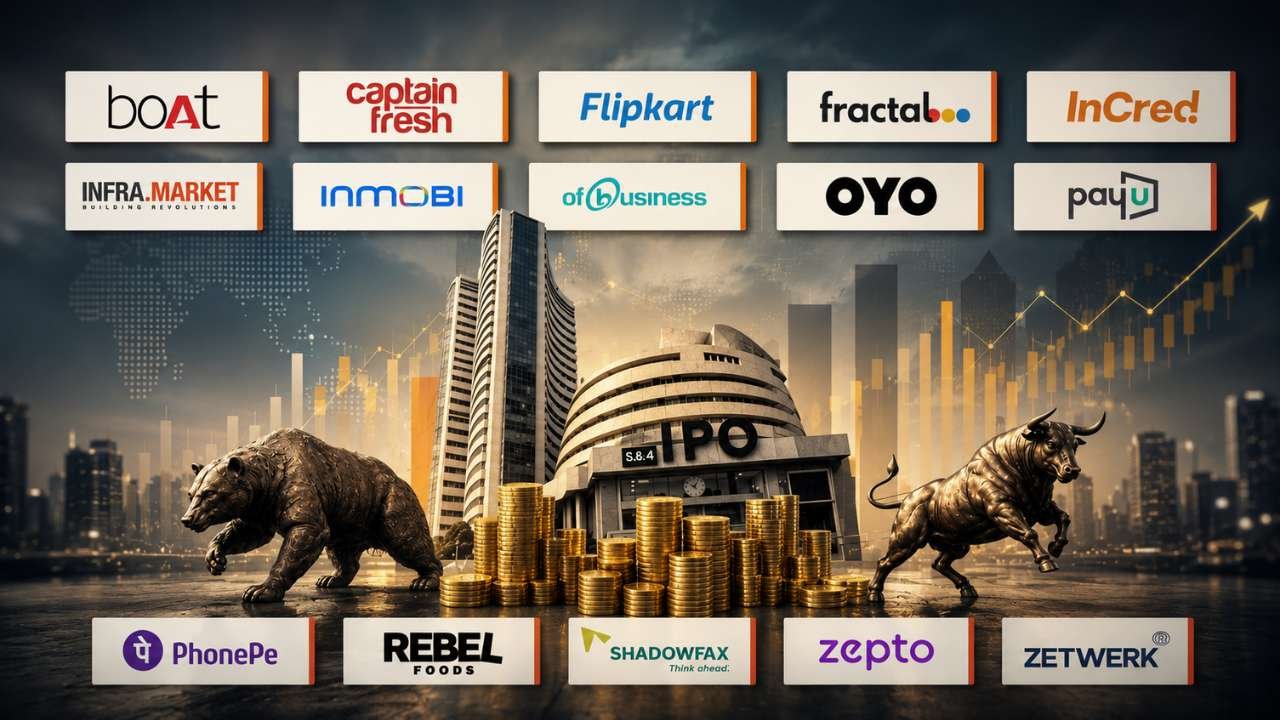
India’s startup ecosystem is set for one of its biggest years in the stock market. More than 48 startups are planning to launch their Initial Public Offerings (IPOs) in 2026, making it one of the busiest years for public listings. Companies from sectors like quick commerce, fintech, software, mobility and consumer technology are preparing to raise funds from investors, even as market uncertainty and global risks continue.
At the same time, India’s stock market is going through an important change. Domestic Institutional Investors (DIIs) are now playing a bigger role than Foreign Institutional Investors (FIIs) in supporting the market. While this has helped keep the market stable, experts say investors should still watch out for several economic and global challenges that could affect the IPO market.
India’s IPO market remains strong despite global challenges
India’s primary market has remained active even with ups and downs in the stock market. Industry estimates suggest that more than 48 startups are expected to go public in 2026, with a combined fundraising target of over ₹2.5 lakh crore. More than half of these companies have already submitted their draft IPO papers, while many others are preparing to do so in the coming months.
The overall IPO market has already created a new record this year. Mainboard IPOs have raised nearly ₹1.8 lakh crore, crossing the previous annual record. Experts believe that more than 190 companies could launch public issues before the end of the year, raising over ₹2.5 lakh crore in total.
However, not every IPO has delivered good returns. While some newly listed companies have given strong gains to investors, others have seen their share prices fall sharply. This shows that investors are now focusing more on companies with strong business performance instead of investing in every new IPO.
The Indian stock market has also seen a major shift in investor participation. Domestic Institutional Investors now hold a slightly larger share in the Nifty 50 than Foreign Institutional Investors. Heavy buying by DIIs has helped balance large-scale selling by FIIs and has supported the market during volatile periods.
Even so, experts warn that several risks remain. High market valuations, rising crude oil prices, global geopolitical tensions, a weak rupee, a large number of upcoming IPOs and uncertainty over a future India-US trade agreement could affect market sentiment in the coming months.
Zepto, PhonePe and OYO lead India’s biggest startup IPO race
Quick commerce company Zepto is expected to be one of the biggest startup IPOs of the year. The company is targeting a valuation of around $10 billion and plans to raise nearly ₹11,000–12,000 crore through its public issue.
Zepto’s latest financial results show both rapid business growth and rising expenses. The company reported a sharp jump in revenue during FY26 as customer demand increased. However, its losses also grew because of higher spending on deliveries, warehouses and employee salaries.
One bright spot for Zepto has been its advertising business. Advertising income has increased rapidly over the last two years and is becoming an important source of revenue as the company works towards improving profitability.
The company is also facing regulatory scrutiny. Its co-founders have been questioned by the Enforcement Directorate (ED) under FEMA-related proceedings. According to the company’s draft IPO documents, the investigation is still ongoing, and future legal developments could become a risk.
Fintech giant PhonePe is also preparing to enter the stock market through an Offer for Sale. Although the company handles a large share of India’s UPI transactions and has a massive user base, some investors remain cautious about its proposed valuation because of the mixed performance of earlier fintech IPOs.
Hospitality company OYO is finally moving closer to its public listing after several years of delays. The company has received regulatory observations for its fresh issue and is now targeting a lower valuation than it had planned earlier.
Other major startups expected to launch IPOs include Cult.fit, Razorpay, CarDekho and PayU, showing that companies from different sectors are ready to enter the public market.
AI disruption and market changes are influencing IPO plans
The rapid growth of artificial intelligence (AI) is also changing the IPO plans of many technology companies. Global technology stocks have become more volatile as AI tools continue to automate several business functions, making investors more careful while valuing software companies.
Because of this, many Indian SaaS startups are now choosing to list on Indian stock exchanges instead of overseas markets. Companies that earlier planned to list on Nasdaq are now focusing on domestic exchanges, where they believe market conditions are more favourable.
Apart from startup IPOs, several large Indian companies are also making major business moves. Coforge is moving ahead with a multi-billion-dollar acquisition, while Shriram Finance is raising fresh capital through a deal with MUFG Bank. HDFC Bank has also sought shareholder approval for large related-party transactions, highlighting the growing scale of corporate activity in India.
With strong support from domestic investors and a record number of companies preparing to go public, 2026 could become a landmark year for India’s IPO market. However, experts believe investors will now pay much more attention to profitability, corporate governance and long-term business strength before investing, rather than focusing only on rapid growth.