

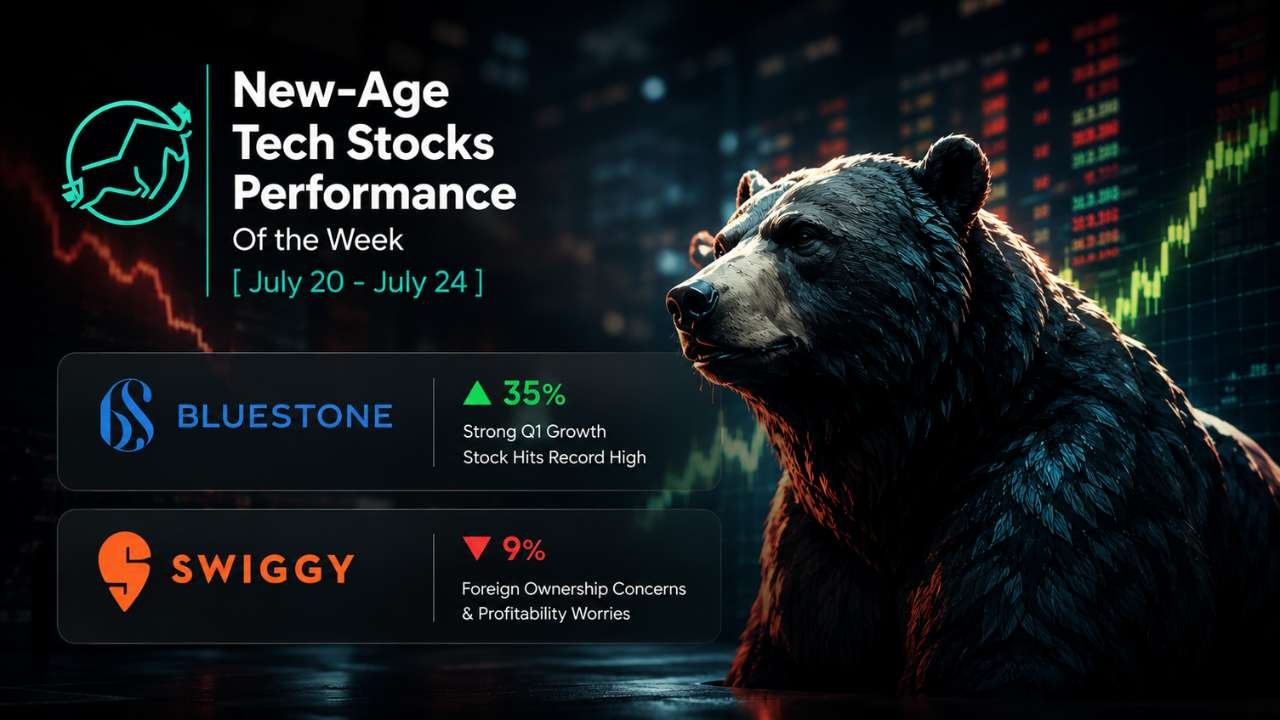
India’s new-age technology stocks had a mixed week in the stock market. Food delivery company Swiggy saw its share price fall sharply, while jewellery retailer BlueStone became one of the biggest winners. The different performances show that investors are now focusing more on companies with strong profits and clear business growth instead of only future potential.
The overall stock market also remained weak because of rising crude oil prices, global tensions, and heavy selling by foreign investors. At the same time, India’s startup sector continues to grow, with investors putting more money into mature companies and regulators introducing stricter rules for technology IPOs.
Swiggy Shares Drop After Foreign Ownership Proposal
Swiggy’s shares fell more than 9% during the week and closed at ₹251.40, moving closer to the company’s all-time low.
The fall came after Swiggy proposed reducing its foreign ownership limit from 100% to 49.5%. The company wants to qualify as an Indian Owned and Controlled Company (IOCC), which would help its quick-commerce business, Instamart.
If Swiggy gets this status, Instamart will be able to buy products directly from suppliers instead of working only as a marketplace. The company will also be able to record the full value of product sales as revenue, which could improve its business model.
However, the market reacted negatively. Investors fear that reducing the foreign ownership limit could make Swiggy ineligible for some global stock indices that require higher foreign shareholding.
According to analysts, if Swiggy is removed from the MSCI Standard Index, it could see around $340 million in passive fund outflows. Another $120 million could flow out if the company is removed from the FTSE index. Together, this could lead to nearly $460 million worth of selling pressure.
The uncertainty also increased trading activity in put options, showing that many traders expect further weakness. Some analysts have also downgraded the stock because they believe Swiggy still faces challenges in becoming profitable.
Investors are especially worried about Instamart. In the fourth quarter of FY26, the quick-commerce business reported a loss of ₹736 crore. Although the loss was slightly lower than the previous quarter, many investors are still unsure whether Instamart can reach its breakeven target by the third quarter of FY27.
BlueStone Reports Strong Growth and Record Share Price
While Swiggy struggled, BlueStone Jewellery had an excellent week. The company’s shares jumped nearly 35% in just two trading sessions and touched a record high of ₹823.20 after announcing strong quarterly results.
BlueStone reported standalone revenue of ₹733 crore in the first quarter of FY27, an increase of nearly 49% compared to the same period last year. The company also posted a standalone net profit of ₹14 crore, compared to a loss of ₹21 crore a year earlier. On a consolidated basis, BlueStone reported a profit of ₹5.96 crore.
The company also showed strong improvement in its operations. Standalone EBITDA rose more than 134% to ₹54.8 crore, while EBITDA margin improved to 7.5%. These results came even after the increase in customs duty on gold, showing that the company managed its costs well.
BlueStone’s retail business also performed strongly. Same-store sales grew by 39%, showing healthy demand from customers. Based on this performance, the company plans to invest ₹400 crore to ₹500 crore to open around 80 new stores this financial year, mainly in Tier-II and Tier-III cities.
Even after the strong rally, some market experts believe the stock has already reached most of its expected short-term upside.
India’s Tech Sector Is Entering a New Phase
The opposite performance of Swiggy and BlueStone shows how investor preferences are changing. Investors are now giving more importance to companies that have stronger financial performance and a clear path to profitability.
The broader Indian stock market also remained under pressure during the week. Rising tensions in the Middle East pushed Brent crude oil prices above $100 per barrel, increasing concerns about India’s import bill and inflation. Since India imports most of its crude oil, higher oil prices can affect the country’s economy and company earnings.
Global factors also added to the pressure. Rising US Treasury yields, weakness in global technology stocks, and continued selling by foreign institutional investors affected market sentiment. However, domestic institutional investors continued buying Indian shares, helping reduce the overall market losses.
India’s startup ecosystem is also becoming more mature. In the first half of 2026, Indian technology startups raised $7.2 billion, even though the total number of funding deals declined sharply. This shows that investors are now investing larger amounts in fewer, well-established startups instead of many early-stage companies.
At the same time, the Securities and Exchange Board of India (SEBI) has introduced stricter rules for technology IPOs. Companies filing IPO documents after April 1, 2025, must provide audited key performance indicators, clearer details about how IPO funds will be used, and stronger corporate governance disclosures. These changes are expected to improve transparency, increase investor confidence, and create a stronger foundation for future technology companies entering the stock market.